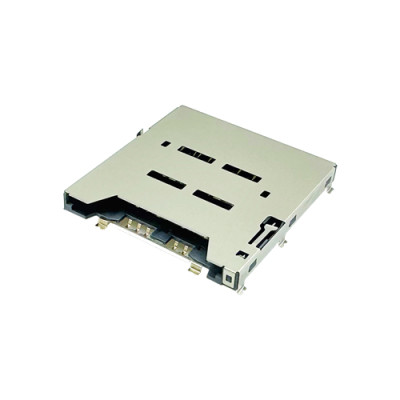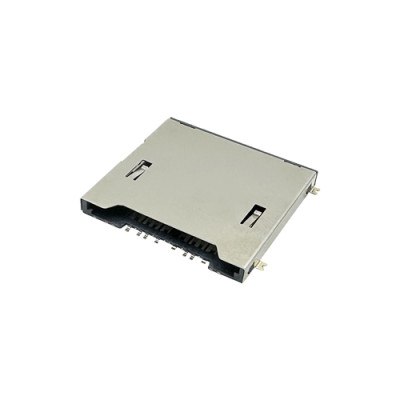
Do you know the main application scenarios of card socket connectors?
Card socket connectors appear wherever a device has to accept a removable card: a SIM for connectivity, an SD card for storage, a chip card for identity or payment. What changes between industries is not the connector family but the specification it has to meet — height in consumer products, thermal and vibration range in automotive, cycle life and contact stability in industrial equipment.
Application Map
| Scenario | Connector family | The specification that binds |
|---|---|---|
| Smartphones, tablets, cameras | Nano SIM, microSD | Height, insertion feel, hot-swap |
| Routers, CPE, communication modules | Nano SIM, microSD | Card detection and long-term contact stability |
| Automotive T-Box, telematics | Nano SIM, microSD | Vibration and -40 to 85°C operation |
| PLC, industrial control | SD, CFast | Cycle life and resistance to dust and shock |
| Medical monitors, imaging | microSD, SD | Retention, cleanability, data integrity |
1. Consumer Electronics
Smartphones, tablets and cameras integrate SIM slots for connectivity and memory-card slots for storage. The Nano SIM socket (4FF, 12.3 x 8.8mm card) exists because a 1.10mm connector fits a 7mm phone; the microSD socket survives because users still want to move media physically. Both depend on hot-swap behaviour: the host must notice the card and power down the interface cleanly, which is a card-detect contact and a firmware sequence rather than a connector feature.
Mechanism choice follows the enclosure. A sealed phone uses a tray so the card enters through the frame; a camera uses push-push because the card must be swapped with the camera in hand. Both are available from 1.28mm, which is close to the practical floor for a socket that will be assembled once and sealed.
2. Communication and Networking Equipment
Routers, 5G CPE, gateways and cellular modules all carry a SIM socket, and increasingly an eSIM alongside it. The requirement here is not height — there is usually room — but long-term contact stability: these devices sit in a cabinet for five years and are expected to re-register on the network after every power cut. Contact resistance that drifts to 60mΩ will produce intermittent registration failures that look like a carrier problem.
This is the segment where 0.025µm gold plating earns its cost. A Nano SIM card connector with proper plating holds 30mΩ or less across -45 to 80°C and through the rated cycle life; a flash-plated part does not, and the failure appears long after the product has shipped.
3. Automotive Electronics
Telematics boxes and T-Boxes use a SIM socket or a soldered eSIM for connectivity, and dash cameras and infotainment units use SD or microSD for storage. The binding requirement is the environment: -40 to 85°C in a cabin or behind a windscreen, continuous vibration, and thermal cycling every day for the life of the vehicle. Automotive programs ask for ISO 16750-3 vibration evidence, and MOARCONN supplies that data alongside IATF 16949 certification.
Two design details decide automotive reliability. Retention force must survive shock without letting the card walk out of the slot, and the plating must hold resistance through thermal cycling rather than just at room temperature. Both are specified numerically, not by mechanism name.
4. Industrial Control Systems
PLCs, machine-vision controllers and data loggers use SD and CFast sockets for program storage, log retrieval and firmware updates. The environment is dusty, sometimes oily, and often vibrating in the 10 to 2000Hz band. Hinge and push-pull mechanisms with exposed contacts are preferred here because they can be inspected and cleaned, and because a jammed ejector in a factory is a maintenance call.
Duty cycle is deceptive in this segment: a logger read once a month for fifteen years sees fewer than 200 insertions, but fifteen years of humidity. Plating thickness, not cycle count, is the specification that decides whether it survives.
5. Medical Devices
Patient monitors, diagnostic instruments and portable imaging devices use SD and microSD sockets to store logs and images. Two requirements are specific to the sector: retention, because a card that dislodges during a procedure loses data that cannot be regenerated; and cleanability, because the housing will be wiped with disinfectant and a push-push ejector is a trap for residue.
Where the device stores patient data on removable media, encryption and access control sit in firmware rather than in the connector — but the connector still has to guarantee that the card is either fully seated or not detected at all. A partially seated card that intermittently reads is worse than no card.
Interfaces Often Confused With Card Sockets
Several connectors in these systems are routinely described as "card connectors" when they are not, and mixing them up leads to the wrong specification. QSFP28 and other optical transceiver cages in base stations are high-speed backplane interfaces, not card sockets. PCIe slots in servers accept expansion cards but follow the PCIe standard, not a memory-card format. M12 circular connectors on industrial cameras are sealed I/O connectors. LVDS links in imaging systems are board-level interfaces. Each has its own standard and its own supplier base; a card socket datasheet tells you nothing about them.
Where the Next Growth Comes From
Three directions are visible. Higher speed, as SD Express pushes a second contact row into mainstream readers. Higher density, with 0.3mm pitch connectors appearing alongside the card sockets on the same board. And higher durability, with 100,000-cycle ratings requested for access-control and transit applications where the card is presented many times a day. Against that, sealed IoT devices are removing the socket entirely in favour of a soldered eSIM, which is why the connector roadmap now runs in two directions at once.
MOARCONN Quality Anchors
Every MOARCONN card socket connector is validated to 10,000 mating cycles (tested to GB/T 5095.7-1997; over 2× the 3,000–5,000 cycles common in the industry), operates from -45°C to 80°C, and ships with contact resistance ≤30mΩ thanks to ≥0.025µm gold-plated phosphor-bronze terminals. IATF 16949 certified production supports 0 MOQ orders with 7-day sampling and a 25-day development cycle — backed by in-house mold, stamping and injection molding factories and 32 granted patents.