How to Improve the Reliability of Micro SD Card Connectors in Industrial and Embedded Applications
How to Improve the Reliability of Micro SD Card Connectors in Industrial and Embedded Applications
Primary Keyword:Micro SD Card Connector
Secondary Keywords:Micro SD Card Connector Reliability, Industrial Micro SD Card Connector, Micro SD Connector Durability, Micro SD Connector Contact Resistance
Introduction
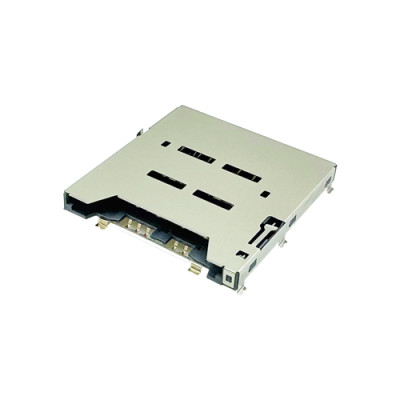
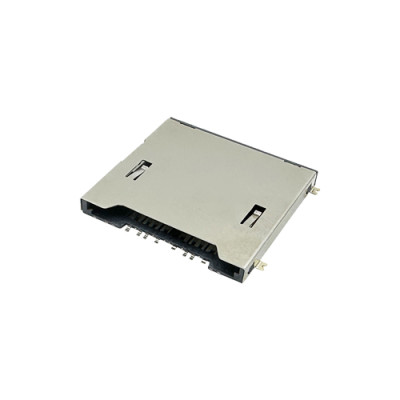
A Micro SD Card Connector is a small but essential component in industrial and embedded electronic devices. It provides a removable storage interface for applications such as industrial controllers, security monitoring systems, communication equipment, and embedded computing devices.
However, repeated insertion, vibration, temperature fluctuations, and humidity can affect connector performance over time. Common problems include intermittent contact, contact wear, card ejection failure, and unexpected card disconnection.
For hardware engineers, selecting a reliable Micro SD Card Connector requires more than checking its dimensions. Contact design, mechanical structure, material selection, PCB integration, and environmental resistance all contribute to long-term performance.
In this guide, MOARCONN shares practical engineering considerations for improving Micro SD Card Connector reliability in industrial and embedded applications.
1. Common Micro SD Card Connector Reliability Problems
Understanding potential failure modes is the first step toward improving connector reliability.
1.1 Intermittent Electrical Contact
Unstable electrical contact may cause card detection failures, read/write errors, and interrupted data transmission.
Possible causes include:
Insufficient contact force.
Contact wear or contamination.
Oxidation of contact surfaces.
Mechanical movement of the card.
Engineering Tip:Evaluate contact geometry, spring force, and contact resistance before and after durability testing.
1.2 Mechanical Wear and Card Ejection Failure
Repeated insertion and removal can wear contact surfaces and affect the connector's locking or ejection mechanism.
Engineering Tip:Select a suitable connector structure and verify insertion force, extraction force, and mating cycle life.
1.3 Vibration-Induced Disconnection
In industrial environments, vibration and mechanical shock may cause card movement or temporary electrical interruption.
Engineering Tip:Evaluate card retention, connector mounting strength, and PCB mechanical support under application-specific conditions.
2. Optimize Contact Design and Material Selection
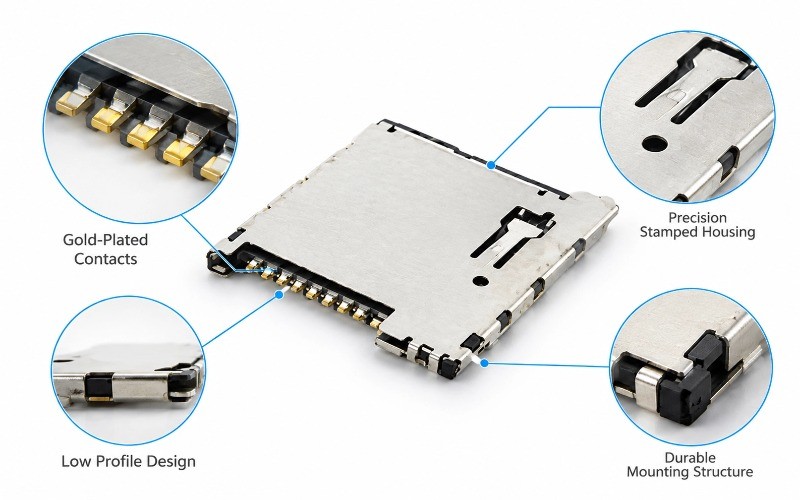
Contact design directly affects the electrical stability and service life of a Micro SD Card Connector.
Important considerations include:
Contact Geometry:Ensure proper terminal alignment and contact wiping distance.
Contact Force:Balance electrical stability with insertion and extraction force.
Contact Material:Select materials with suitable conductivity and mechanical properties.
Surface Plating:Evaluate plating material, thickness, and corrosion resistance.
Contact Resistance:Verify resistance under initial and post-durability conditions.
Gold plating may improve corrosion resistance and contact performance, but overall reliability also depends on contact design, plating quality, and operating conditions.
MOARCONN Engineering Focus
MOARCONN develops and manufactures card socket connectors with attention to precision metal stamping, contact structure, and manufacturing consistency. Customized Micro SD Card Connector solutions can be evaluated according to specific application and mechanical requirements.
3. Improve Mechanical Durability and Card Retention
Different Micro SD connector mechanisms offer different mechanical characteristics.
3.1 Choose the Right Connector Structure
Push-Push Connector
Convenient card insertion and ejection.
Integrated spring locking mechanism.
Suitable for applications requiring frequent card replacement.
Requires validation of spring durability and ejection force.
Push-Pull Connector
Simple manual insertion and removal.
Potentially compact mechanical structure.
Suitable for applications with less frequent card replacement.
Requires appropriate card retention and removal clearance.
Hinged Connector
Uses a movable cover or locking structure.
Provides positive card positioning.
Suitable for applications requiring secure mechanical retention.
Requires evaluation of hinge and locking durability.
The best structure depends on the application's mechanical requirements rather than one design being universally superior.
3.2 Strengthen PCB Mechanical Support
Connector reliability also depends on PCB integration.
Engineers should check:
Correct PCB footprint and solder pad design.
Mounting peg positioning.
PCB thickness and rigidity.
Mechanical clearance around the card slot.
Solder joint strength.
For devices involving frequent card replacement, sufficient mechanical support helps reduce stress on solder joints and PCB connections.
MOARCONN Engineering Focus
MOARCONN offers different Micro SD card connector structures, including Push-Push, Push-Pull, and Hinged types. Customized connector development is also available for projects requiring special dimensions, mounting configurations, or mechanical structures.
4. Improve Environmental Resistance
Industrial and embedded devices may operate under challenging environmental conditions.
4.1 Temperature and Humidity
Temperature fluctuations can affect contact spring characteristics, material dimensions, and solder joints. High humidity may accelerate corrosion and contamination.
Engineers should verify:
Operating temperature range.
Humidity resistance.
Contact plating specifications.
Environmental test performance.
4.2 Vibration and Mechanical Shock
Vibration may cause card movement, contact instability, or mechanical damage.
Evaluate card retention, housing strength, PCB mounting stability, and electrical continuity under the expected vibration conditions.
4.3 ESD Protection
Electrostatic discharge can enter through user-accessible card interfaces and affect the host electronics.
Recommended system-level protection includes:
ESD protection components.
Proper grounding.
Optimized PCB routing.
Appropriate discharge paths.
A Micro SD Card Connector itself should not be considered an ESD protection device.
5. PCB Layout and SMT Assembly Considerations
A reliable Micro SD Card Connector also requires proper PCB design and manufacturing processes.
Before PCB production, engineers should verify:
Connector dimensions and PCB footprint.
Terminal pitch and solder pad dimensions.
Mounting peg locations.
Card insertion and extraction clearance.
Mechanical keep-out areas.
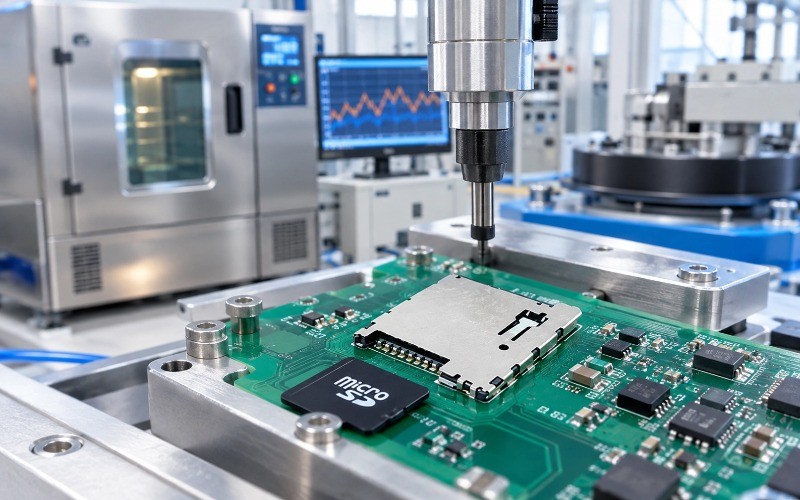
During SMT assembly, attention should be given to solder paste printing, component placement, terminal coplanarity, reflow temperature profiles, and solder joint inspection.
The manufacturer's datasheet should always be used as the reference for mounting and soldering requirements.
MOARCONN Manufacturing Capabilities
MOARCONN provides precision stamping, injection molding, connector assembly, and product inspection. Our services also cover DFM evaluation, tooling development, prototype production, and mass production.
These capabilities support customers in developing Micro SD Card Connector solutions that meet their product design and manufacturing requirements.
6. Reliability Testing and Validation
Reliability testing helps verify whether a Micro SD Card Connector can maintain its electrical and mechanical performance throughout its expected service life.
Common testing methods include:
| Test Item | Purpose |
| Contact Resistance Test | Verify electrical contact stability |
Insertion/Extraction Cycle Test | Evaluate mechanical durability |
Insertion Force Test | Check operating force |
Card Retention Test | Verify card stability |
Vibration Test | Evaluate electrical continuity |
Mechanical Shock Test | Check mechanical strength |
Temperature Cycling | Verify thermal stability |
Humidity Test | Evaluate moisture resistance |
ESD Test | Validate system-level protection |
For example, the GCT MEM2067 specification describes 5,000 insertion and extraction cycles and provides specific contact resistance and vibration test criteria.
These values apply to that particular model and its specified test conditions, not to all Micro SD Card Connectors.
Engineers should select test conditions based on the application and verify the results against the manufacturer's specifications.
7. How to Choose the Right Micro SD Card Connector
Before selecting a connector, engineers should evaluate the following requirements:
| Selection Factor | Key Consideration |
Application Environment | Temperature, humidity, vibration |
| Connector Structure | Push-Push, Push-Pull, Hinged |
Electrical Performance | Contact resistance, rated current |
Mechanical Performance | Mating cycles, insertion force, retention |
PCB Design | Footprint, mounting height, clearance |
Manufacturing | SMT compatibility and assembly process |
Customization | Special dimensions or mechanical requirements |
Why Choose MOARCONN?
Founded in 2010, MOARCONN specializes in card socket connector development and manufacturing.
Our product portfolio includes Micro SD, SD, SIM, and Smart Card Connectors in different mechanical structures and mounting configurations.
We provide:
Standard and customized card connector solutions.
Precision stamping and injection molding.
Connector design and DFM support.
Tooling development and prototype production.
Assembly, inspection, and mass production.
OEM/ODM development support.
Whether you are developing industrial controllers, security monitoring equipment, communication devices, or embedded systems, MOARCONN can help evaluate a suitable Micro SD Card Connector solution based on your project requirements.
Frequently Asked Questions
1. How many insertion cycles can a Micro SD Card Connector support?
The mating cycle life depends on the connector design and manufacturer specifications. Some models are rated for 5,000 or more insertion and extraction cycles. Always verify the specific datasheet.
2. What causes intermittent contact in Micro SD Card Connectors?
Common causes include contact wear, insufficient contact force, contamination, corrosion, mechanical movement, and PCB solder joint problems.
3. How can Micro SD Connectors improve vibration resistance?
Select an appropriate card retention structure, ensure stable PCB mounting, and validate electrical continuity through application-specific vibration testing.
4. Does gold plating improve connector reliability?
Gold plating can improve corrosion resistance and contact performance. However, contact geometry, plating thickness, material quality, and operating conditions also influence reliability.
5. Can Micro SD Card Connectors be customized?
Yes. Depending on project requirements, customization may include connector height, mounting orientation, contact configuration, housing dimensions, and mechanical structure.
MOARCONN provides customized card connector development and OEM/ODM support for different electronic applications.
Conclusion: Build More Reliable Products with the Right Micro SD Card Connector
Improving Micro SD Card Connector reliability requires attention to contact design, material selection, mechanical retention, environmental resistance, PCB integration, and reliability testing.
For industrial and embedded applications, engineers should select connectors based on actual operating conditions rather than focusing only on size or cost.
At MOARCONN, we provide standard and customized Micro SD Card Connector solutions, supporting customers from product design and prototype development to mass production.
Looking for a reliable Micro SD Card Connector for your next project?
Contact MOARCONN to discuss your application requirements and explore a suitable connector solution.
MOARCONN – Your Partner for Micro SD Card Connector Solutions.
Website: https://www.moarconn.com/