Learn how to choose the right SD Card Connector for your PCB design, with expert tips on types, specs, and applications.
SD Card Connectors: A Complete Selection Guide for Hardware Engineers
Introduction
SD card connectors are widely used in industrial equipment, consumer electronics, automotive systems, medical devices, and data storage applications. Choosing the right SD Card Connector is essential for reliable electrical connections, stable card retention, and long-term performance.
However, different applications require different connector sizes, mounting styles, contact configurations, and ejection mechanisms.
This guide explains the key factors hardware engineers should consider when selecting an SD card connector for PCB design.
1. What Is an SD Card Connector?
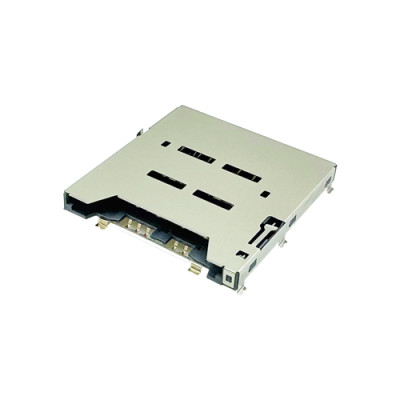
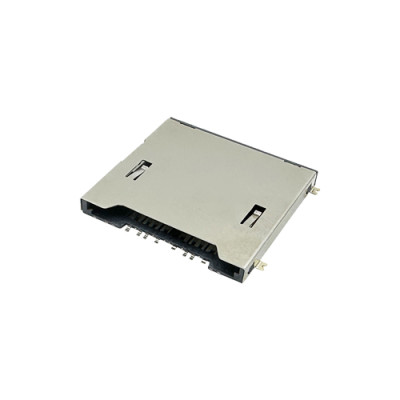
An SD Card Connector, also called an SD card socket, is an electromechanical component that connects an SD memory card to a host device's PCB.
It typically consists of:
Metal shielding:Protects internal components and provides mechanical support.
Contact terminals:Establish electrical connections with the memory card.
Plastic housing:Holds and positions the card.
Card retention mechanism:Keeps the card securely in place.
Detection switch:Detects card insertion or removal when included in the design.
The connector provides the physical interface, while actual data transfer performance depends on the memory card, host controller, interface standard, PCB layout, and signal integrity.
2. Common Types of SD Card Connectors
SD card connectors are available in several formats.
Standard SD Connector:Designed for full-size SD cards, commonly used in cameras, card readers, and industrial equipment.
Mini SD Connector:Designed for MiniSD cards, which are less common in modern products.
Micro SD Connector:A compact solution widely used in portable electronics, embedded systems, and industrial devices.
The connector must match the memory card format and the available PCB space.
3. Common SD Card Connector Mechanisms
The ejection mechanism affects usability, card retention, and product structure.
Push-Push SD Card Connector
A push-push connector uses a spring-loaded mechanism. Users push the card to insert or release it.
Advantages:Convenient operation and a compact design.
Applications:Cameras, portable devices, and embedded electronics.
Push-Pull SD Card Connector
A push-pull connector allows users to insert and remove the card manually.
Advantages:Simple structure and straightforward operation.
Applications:Devices where easy access and a simple mechanical design are preferred.
Hinged and Tray-Type Connectors
Hinged connectors use a movable cover to secure the card. Tray-type connectors hold the card in a removable tray.
These designs can provide stable card positioning and may be suitable for products requiring specific retention or assembly arrangements.
4. Key Specifications to Consider
Before selecting an SD Card Connector, engineers should evaluate the following specifications.
| Specification | What to Check |
| Card format | SD, MiniSD, or MicroSD |
| Mounting type | Top mount, bottom mount, or side mount |
| Connector height | Available PCB and enclosure clearance |
Contact configuration | Compatibility with the required card interface |
Ejection mechanism | Push-push, push-pull, hinged, or tray |
Durability | Rated insertion and removal cycles |
Operating temperature | Application-specific temperature range |
Electrical performance | Contact resistance and signal integrity |
Always check the manufacturer's datasheet for the exact model. Specifications can vary between connector series.
5. PCB Design Considerations
Correct PCB integration is essential for reliable connector performance.
Footprint and dimensions:Confirm the recommended PCB footprint, pad layout, mounting points, and mechanical tolerances.
Component clearance:Check the connector height, card insertion path, and ejection space inside the enclosure.
Signal integrity:Follow the applicable interface requirements and the connector manufacturer's layout recommendations, especially for high-speed applications.
Mechanical stability:Ensure that solder joints and mounting features can withstand expected insertion forces and vibration.
Engineers should review both the electrical specifications and mechanical drawings before finalizing the PCB design.
6. Common Selection Mistakes
Avoid these common mistakes when choosing an SD card connector:
Selecting a connector that does not match the card format.
Ignoring the available PCB and enclosure space.
Choosing an unsuitable ejection mechanism.
Overlooking operating temperature and vibration requirements.
Assuming all connectors support the same data interface or speed.
Using an incorrect PCB footprint.
Reviewing the datasheet and testing the connector in the actual application can help prevent costly redesigns.
7. Applications of SD Card Connectors
SD and Micro SD card connectors are used in a wide range of electronic products, including:
Industrial control systems and automation equipment
Automotive electronics and vehicle data systems
Medical and monitoring equipment
Cameras, video recorders, and security systems
Computers, tablets, and portable devices
Embedded systems and data storage equipment
Each application may require different connector dimensions, retention mechanisms, and environmental performance.
8. Why Choose MOARCONN SD Card Connectors?
MOARCONN is a manufacturer specializing in SD card, Micro SD card, SIM card, and smart card connectors. Founded in 2010, the company integrates product development, engineering, manufacturing, and sales.
MOARCONN provides connector solutions for industrial, automotive, medical, and consumer electronics applications.
Key capabilities include:
A range of SD and Micro SD connector designs.
In-house mold design and manufacturing capabilities.
Engineering support for customized connector requirements.
Product development and manufacturing experience.
Quality management systems including ISO 9001, IATF 16949, ISO 13485, and ISO 14001 at the company level.
Whether you need a standard SD Card Connector or a customized solution, MOARCONN can support your project from connector selection to product development.
Visit MOARCONN to explore available connector solutions.
9. SD Card Connector Selection Checklist
Before choosing a connector, confirm the following:
Is the connector compatible with the required memory card?
Does its height fit the product enclosure?
Is the mounting style suitable for the PCB?
Does the ejection mechanism meet user requirements?
Are the electrical specifications compatible with the application?
Can it withstand the expected operating environment?
Has the PCB footprint been verified against the datasheet?
A systematic review of these factors can help engineers select a reliable connector and reduce development risks.
10. Frequently Asked Questions
What is the difference between an SD card connector and a Micro SD connector?
The main difference is the supported memory card format and physical dimensions. Standard SD connectors accommodate full-size SD cards, while Micro SD connectors are designed for smaller Micro SD cards.
How do I choose the right SD Card Connector for PCB design?
Consider card format, mounting type, connector height, electrical specifications, mechanical clearance, and operating environment. MOARCONN provides different connector options to support various PCB designs.
Are all SD card connectors suitable for high-speed applications?
No. High-speed compatibility depends on the specific connector design, card interface, host controller, and PCB signal integrity. Always verify the datasheet before selecting a model.
Can SD card connectors be customized?
Yes. Depending on project requirements, MOARCONN can support customized connector development, including mechanical dimensions, mounting structures, and other design requirements.
Conclusion
Selecting the right SD Card Connector requires balancing electrical performance, mechanical design, PCB space, and application requirements.
By checking the connector datasheet and evaluating the operating environment early in development, engineers can improve product reliability and avoid unnecessary redesigns.
MOARCONN offers SD and Micro SD connector solutions backed by engineering and manufacturing capabilities to support a wide range of electronic applications.