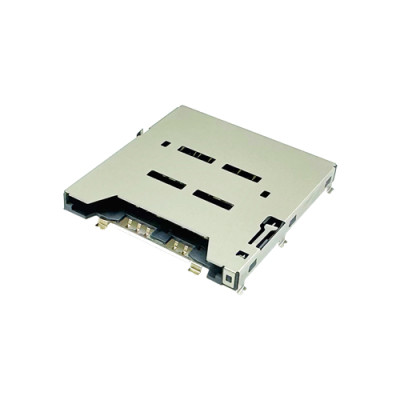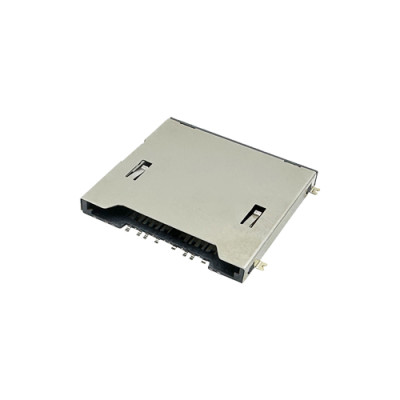
Micro SD Card Connector Reliability: Contact Design, Durability, ESD & Environmental Performance
Micro SD Card Connector Reliability: Contact Design, Durability, ESD & Environmental Performance
A Micro SD card connector is a small but critical component in devices that rely on removable memory. Poor connector reliability can lead to intermittent card detection, read/write errors, data transmission instability, and premature product failure.
For engineers, choosing a reliable Micro SD card connector means looking beyond dimensions and price. Contact design, mating durability, mechanical retention, ESD, environmental resistance, and PCB assembly all affect long-term performance.
With more than 20 years of connector experience, Moarconn provides standard and customized Micro SD card connector solutions for consumer electronics, industrial equipment, security systems, communications equipment, and other applications.
What Determines Micro SD Card Connector Reliability?
A reliable Micro SD card connector needs to maintain stable electrical contact and mechanical performance throughout its intended service life.
The main reliability factors include:
Contact design and contact force
Contact resistance and plating
Mating and unmating durability
Card retention and mechanical stability
ESD and EMI performance
Temperature and humidity resistance
Vibration and shock resistance
PCB soldering and assembly reliability
These factors should be evaluated together rather than independently.
1. Contact Design and Contact Reliability
The contact system is at the heart of Micro SD card connector performance.
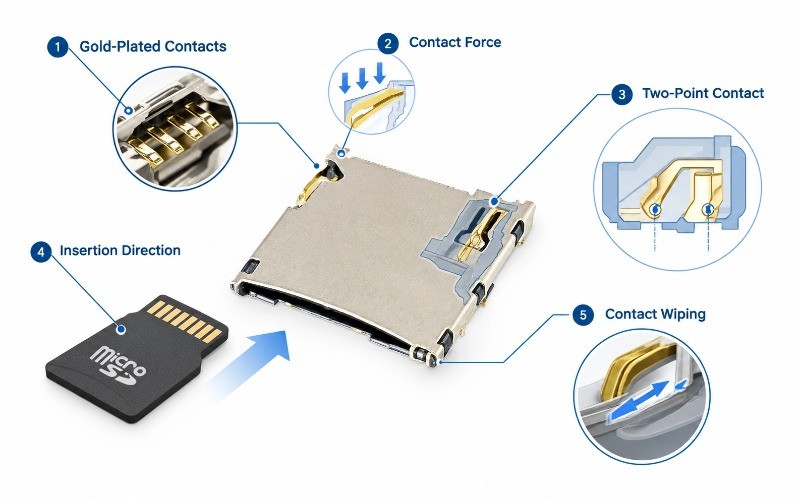
A well-designed contact should provide sufficient contact force while minimizing insertion and extraction resistance. Contact geometry also needs to accommodate repeated card insertion without excessive wear.
Important parameters include:
Contact material
Contact force
Contact geometry
Contact resistance
Plating
Contact wiping action
Expected mating cycles
Some Micro SD connector designs use two-point contact structures to improve electrical stability. Yamaichi, for example, specifies a two-point contact design together with card detection and mis-insertion prevention features. Its referenced Micro SD connector is rated for 10,000 mating cycles. (Yamaichi)
For engineers, the key question is not simply whether a connector uses gold plating, but whether the complete contact system can maintain stable resistance throughout the required operating life.
Moarconn engineering focus: Contact geometry, terminal material, plating, and spring characteristics can be optimized according to application requirements.
2. Micro SD Card Connector Durability
Repeated insertion and removal can gradually affect contact surfaces, springs, housings, and the card retention mechanism.
The required mating-cycle rating depends on the application.
For example, OSE publishes durability testing of 10,000 mating cycles for non-UHS-II Micro SD connectors and 5,000 cycles for UHS-II Micro SD connectors. These figures are useful reference examples rather than universal requirements. (OSE)
Engineers should evaluate:
Mating cycles
Insertion force
Extraction force
Contact resistance after cycling
Card retention
Ejection mechanism durability
For products where the Micro SD card is frequently replaced, mating durability becomes especially important.
3. Card Retention, Vibration and Shock
Mechanical stability directly affects electrical reliability.
In industrial equipment, vehicles, security devices, and portable products, vibration or shock can cause microscopic movement between the card and connector contacts.
This may lead to:
Vibration → Micro-movement → Contact wear → Intermittent connection
A reliable Micro SD card connector may therefore require:
Strong card retention
Stable contact force
Anti-misalignment features
Anti-mis-insertion protection
Robust housing
Secure PCB anchoring
Yamaichi's design, for example, incorporates a card fly-out brake and mis-insertion prevention features. (Yamaichi)
Moarconn also evaluates mechanical factors such as card retention, contact spring force, PCB anchoring, and structural strength during connector qualification.
4. ESD and EMI Considerations
Because the Micro SD interface is accessible to users, ESD should be considered during system design.
An ESD event can enter through the card interface and potentially affect the connector contacts, PCB, or host controller.
Engineers should evaluate:
Connector shell grounding
PCB ground structure
ESD protection components
Signal routing
Shielding
Discharge paths
OSE's published Micro SD/SD reliability testing references IEC 61000-4-2 for ESD evaluation. (OSE)
Importantly, ESD protection is a system-level consideration. A Micro SD card connector should not be considered an ESD protection device by itself.
For high-speed applications, EMI and signal integrity should also be evaluated as part of the complete:
Micro SD Card → Connector → PCB → Host Controller
signal path.
5. Environmental Performance
Environmental conditions can accelerate connector degradation.
Key factors include:
Temperature
Thermal cycling can cause expansion and contraction of different materials, affecting contact force, housing dimensions, and solder joints.
Humidity
High humidity can accelerate corrosion or contamination of exposed metallic surfaces and increase contact resistance.
Corrosion
For outdoor or industrial applications, corrosion resistance may become a major selection criterion.
Vibration and Shock
Mechanical stress can cause contact movement and connector or solder-joint fatigue.
OSE's published testing includes temperature/humidity, salt spray, drop, bending, torque, and other reliability evaluations, demonstrating the range of environmental and mechanical conditions that may need to be considered for Micro SD interfaces. (OSE)
The correct environmental specification should always be determined according to the final product's operating conditions.
6. PCB Assembly Reliability
Connector reliability does not end at the connector itself.
A Micro SD card connector must also form a reliable connection with the PCB.
Important manufacturing factors include:
SMT compatibility
Reflow performance
Coplanarity
Solder-joint strength
PCB anchoring
Terminal alignment
Automated inspection
Moarconn's connector manufacturing process integrates precision stamping, injection molding, assembly, inspection, and reliability verification to support consistent production quality.
This is particularly important for OEM and ODM projects requiring customized dimensions, mounting structures, or mechanical features.
7. Micro SD Card Connector Reliability Testing Checklist
Before approving a connector for mass production, engineers can use the following checklist:
| Test / Specification | Purpose |
| Contact Resistance | Verify electrical stability |
Mating Cycle Test | Evaluate contact and mechanical durability |
Insertion / Extraction Force | Check mechanical performance |
Card Retention | Evaluate vibration resistance |
Temperature Cycling | Evaluate thermal reliability |
Humidity Test | Check moisture resistance |
Corrosion Test | Evaluate material/plating durability |
Vibration / Shock | Verify mechanical stability |
ESD Test | Evaluate interface/system robustness |
| SMT / Reflow Test | Verify PCB assembly compatibility |
| Signal Integrity | Evaluate high-speed performance |
Testing conditions should be defined according to the application and applicable standards rather than relying on a single universal test value.
How to Choose a Reliable Micro SD Card Connector
Before selecting a connector, engineers should ask:
1. How many mating cycles are required?
Determine how frequently the card will be inserted and removed.
2. What is the operating environment?
Consider temperature, humidity, vibration, shock, and corrosion.
3. What mechanical structure is required?
Choose between Push-Push, Push-Pull, Hinge, top-mount, reverse-mount, and other configurations.
4. What electrical performance is required?
Check contact resistance, plating, grounding, shielding, and signal integrity.
5. Does the connector fit the PCB and enclosure?
Verify footprint, connector height, mounting structure, and reflow requirements.
6. Can the supplier provide customization?
Custom contact geometry, housing dimensions, retention structures, and mounting features may be necessary for specialized products.
Why Choose Moarconn for Micro SD Card Connectors?
Moarconn specializes in SD, Micro SD, SIM, and smart card connectors, with more than 20 years of connector development and manufacturing experience.
Our Micro SD card connector solutions include:
Push-Push Micro SD connectors
Push-Pull Micro SD connectors
Hinge-type connectors
SMT and DIP configurations
Customized connector structures
Precision stamping and molding
OEM/ODM development
Prototype to mass production
Moarconn's experience covers applications including industrial equipment, security systems, communications, automotive electronics, consumer electronics, and smart devices.
For projects with specific requirements for connector height, card retention, mating durability, contact design, environmental performance, or PCB integration, a customized Micro SD card connector can often provide a better solution than adapting a standard component.
Frequently Asked Questions
How reliable is a Micro SD card connector?
Reliability depends on contact design, materials, mating cycles, mechanical retention, environmental conditions, PCB assembly, and application requirements.
How many times can a Micro SD card connector be inserted?
The rated mating life varies by connector design. Published examples include thousands of mating cycles, with some products rated at 5,000 or 10,000 cycles. Always verify the manufacturer's specific test conditions.
What causes Micro SD connector failure?
Common causes include contact wear, insufficient contact force, corrosion, contamination, vibration, mechanical damage, solder-joint fatigue, and poor system-level ESD or PCB design.
Are gold-plated Micro SD contacts more reliable?
Gold plating can improve wear and corrosion performance, but plating alone does not determine connector reliability. Contact geometry, force, base material, plating specification, and environmental conditions must be considered together.
Can Micro SD card connectors be customized?
Yes. Depending on the manufacturer, customization may include connector height, mounting configuration, contact design, retention mechanism, housing structure, shielding, and PCB footprint.
Conclusion
A reliable Micro SD card connector must provide stable electrical contact, mechanical durability, and environmental resistance throughout the product lifecycle.
When selecting a connector, engineers should evaluate:
Contact Design + Durability + Retention + ESD/EMI + Environment + PCB Assembly
rather than focusing only on dimensions or price.
With its experience in connector design, precision manufacturing, reliability testing, and OEM/ODM development, Moarconn can support customers from initial connector requirements through prototype validation and mass production.