Micro SD Card Connectors: An Engineer’s Guide to Selecting the Right Connector for Embedded Applications
Micro SD Card Connectors: An Engineer’s Guide to Selecting the Right Connector for Embedded Applications
Meta Description
Learn how to select the right Micro SD Card Connectors for embedded applications. Explore connector types, PCB design considerations, reliability factors, and engineering solutions from MoarConn, an experienced Micro SD connector manufacturer.
Introduction
In modern embedded systems, storage reliability depends not only on the memory card itself but also on the quality and design of the Micro SD Card Connector.
From industrial controllers and security cameras to IoT gateways and portable devices, engineers need connectors that provide:
Stable electrical contact
Reliable mechanical retention
Compact PCB integration
Long-term durability under repeated use
Selecting the right Micro SD Card Connector is often overlooked during product development. However, connector failure can lead to:
Data transmission interruption
Storage detection errors
Product returns
Increased maintenance costs
This engineer’s guide explains the key factors hardware designers should evaluate when selecting Micro SD Card Connectors for embedded applications.
1. Understanding the Role of Micro SD Card Connectors in Embedded Systems
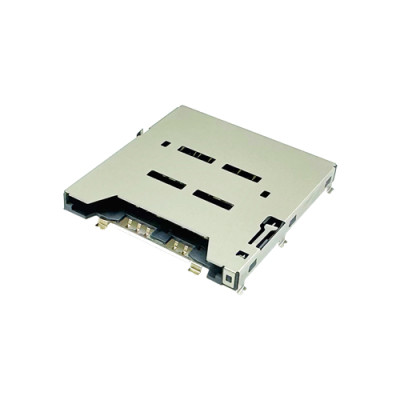
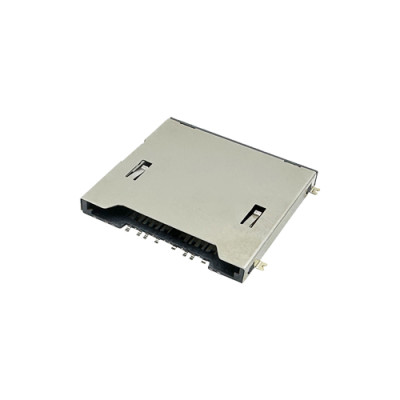
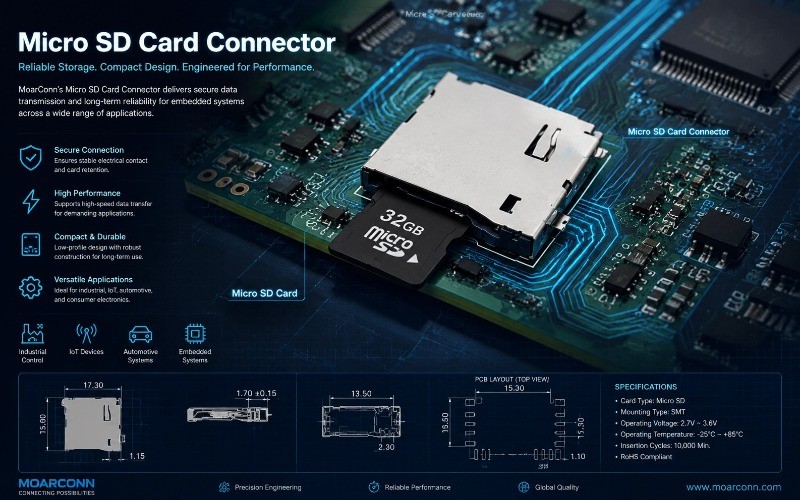
A Micro SD Card Connector is the mechanical and electrical interface between the Micro SD memory card and the host PCB.
It performs three critical functions:
1.1 Electrical Connection
The connector provides reliable contact between:
VDD power
Ground
Data lines
Clock signal
Command signal
Card detection switch
Modern micro SD systems support different communication methods including:
SPI mode
SD bus interface
High-speed SD protocols
Engineers must ensure the connector design supports the required transmission performance.
1.2 Mechanical Retention
Besides electrical connection, the connector must:
Hold the card securely
Maintain contact pressure
Resist vibration
Support insertion and removal cycles
For embedded products used in industrial environments, mechanical reliability is equally important as electrical performance.
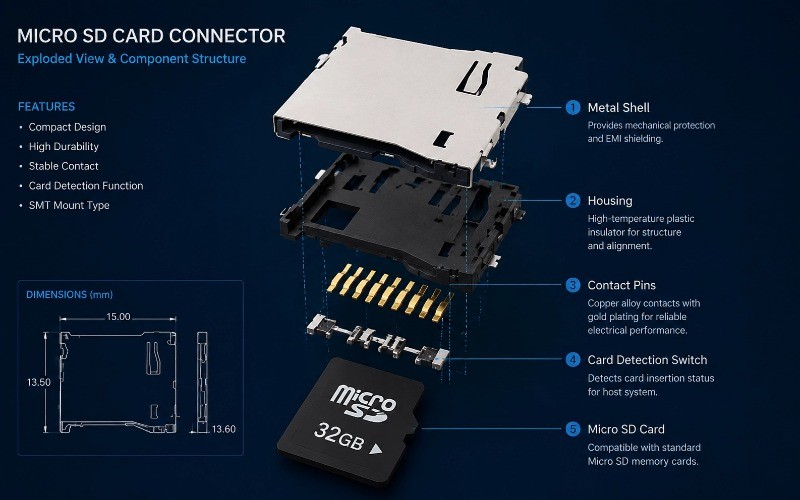
2. Main Types of Micro SD Card Connectors
Choosing the correct connector mechanism depends on product requirements.
2.1 Push-Push Micro SD Card Connector
Working Principle
The user presses the card:
First press → lock card
Second press → eject card
Advantages:
Excellent user experience
Easy card replacement
Compact design
Typical Applications:
Cameras
Consumer electronics
Portable devices
However, designers should evaluate mechanical durability because the eject mechanism contains moving components.
2.3 Hinged Micro SD Card Connector
The hinged design provides additional card retention.
Advantages:
Better vibration resistance
Secure card positioning
Suitable for harsh environments
Applications:
Automotive electronics
Outdoor equipment
Industrial IoT devices
Engineer Comparison Table
Feature Push-Push Push-Pull Hinged
User convenience ★★★★★ ★★★ ★★★
Mechanical simplicity ★★★ ★★★★★ ★★★★
Vibration resistance Medium High Very High
Consumer application Excellent Medium Low
Industrial application Medium Excellent Excellent
3. Key Specifications Engineers Should Evaluate Before Selecting Micro SD Card Connectors
3.1 Connector Size and PCB Footprint
Embedded products continue to become smaller.
Important parameters:
Connector height
PCB area
Mounting direction
Keep-out area
Low-profile Micro SD connectors help designers optimize compact products.
3.2 Mounting Type: SMT vs Through Hole
SMT Micro SD Connector
Benefits:
Space saving
Suitable for automated assembly
Supports compact PCB layouts
Through-Hole Connector
Benefits:
Higher mechanical strength
Better for high vibration environments
3.3 Contact Material and Plating
Connector contact quality affects:
Signal stability
Corrosion resistance
Product lifetime
Important considerations:
Gold plating thickness
Contact spring force
Contact resistance
3.4 Mating Cycle Rating
Engineers should consider expected usage frequency.
Examples:
Consumer device:
Hundreds of insertions
Industrial equipment:
Thousands of cycles
Some memory card connectors available in the market specify reliability ratings up to thousands of mating cycles.
4. PCB Design Considerations for Micro SD Card Connectors
Selecting a connector is only the first step.
Correct PCB implementation affects system reliability.
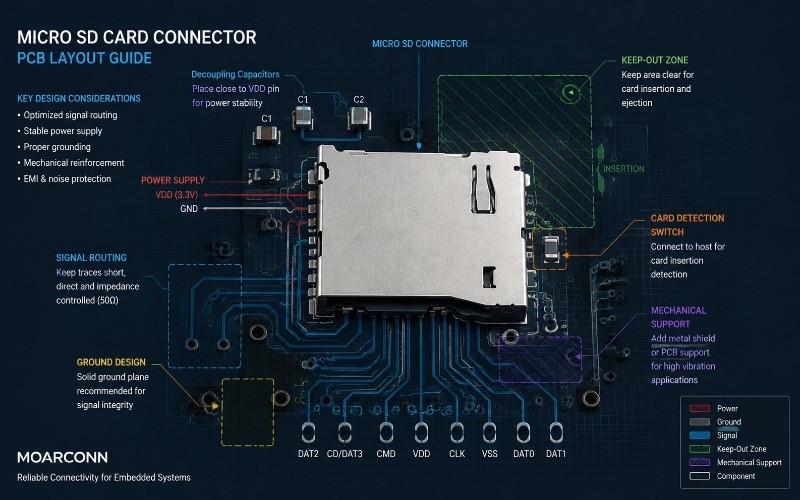
4.1 Signal Routing
Recommended practices:
Keep SD signal traces short
Avoid unnecessary vias
Maintain signal integrity
4.2 Power Stability
Design considerations:
Place decoupling capacitors near power pins
Minimize voltage fluctuation
4.3 Mechanical Reinforcement
For industrial applications:
Consider:
PCB support
Connector mounting strength
Shock resistance
5. Common Micro SD Connector Failure Problems and Solutions
Problem 1: Intermittent Card Detection
Possible causes:
Poor contact pressure
Contamination
Connector wear
Solution:
Select connectors with:
Stable contact structure
Reliable plating
Proper spring force
Problem 2: Card Loosening During Operation
Possible causes:
Vibration
Insufficient retention
Solution:
Use:
Locking mechanisms
Hinged structures
Reinforced connector designs
Problem 3: Connector Damage During Assembly
Possible causes:
Incorrect PCB footprint
Excessive insertion force
Solution:
Verify:
Mechanical drawings
Assembly process
Connector specification
6. How MoarConn Helps Engineers Select the Right Micro SD Card Connector
Engineering Support From Concept to Mass Production
At MoarConn, we focus on the research, development, and manufacturing of card connectors including:
SD Card Connectors
SIM Card Connectors
Smart Card Connectors
With years of experience in precision molds and connector manufacturing, MoarConn provides:
Customized Connector Solutions
Engineers can work with MoarConn for:
Custom connector design
Mechanical structure optimization
Mold development
Product customization
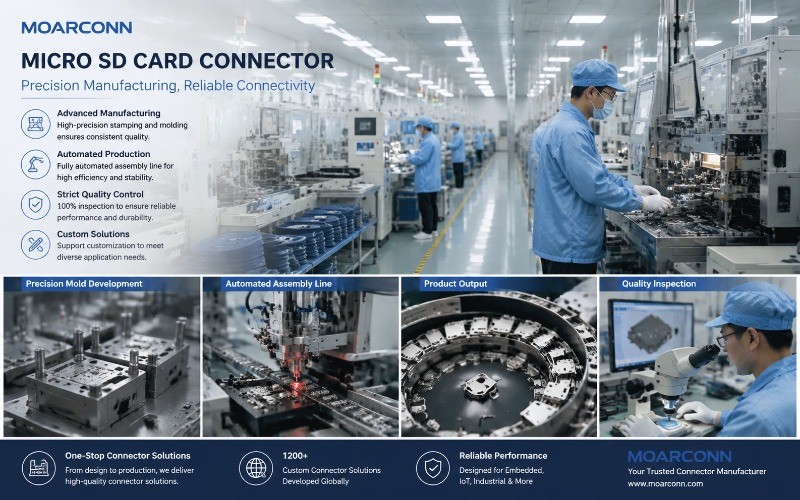
Manufacturing Capability
Our service covers:
1.Product design support
2.Precision tooling
3.Connector production
4.Assembly
5.Quality support
MoarConn has developed more than 1,200 customized connector solutions and provides Micro SD connector solutions for applications such as security monitoring equipment requiring high strength, stability, and transmission reliability.
7. Engineer Checklist: Before Choosing a Micro SD Card Connector Supplier
Before finalizing your design, verify:
Technical Requirements
☐ Compatible micro SD specification
☐ Required insertion mechanism
☐ PCB footprint availability
☐ Signal performance requirement
☐ Operating temperature range
Reliability Requirements
☐ Contact durability
☐ Mating cycle rating
☐ Vibration resistance
☐ Production consistency
Supplier Capability
☐ Engineering support
☐ Customization ability
☐ Prototype availability
☐ Mass production capability
Conclusion
Selecting the right Micro SD Card Connector is an important engineering decision that affects product reliability, user experience, and long-term performance.
For embedded applications, engineers should evaluate more than connector price. Mechanical structure, electrical reliability, PCB compatibility, and supplier manufacturing capability all determine the success of the final product.
With professional expertise in card connector development and manufacturing, MoarConn provides reliable Micro SD Card Connector solutions for global embedded electronics manufacturers.