Micro SD Card Connectors: Engineering Insights on Operation & Signal Integrity
Micro SD Card Connectors: Engineering Insights on Operation & Signal Integrity
Micro SD Card Connectors are a critical component in modern embedded systems, consumer electronics, and industrial devices, providing the physical and electrical interface between removable flash storage and the host PCB. Understanding how they work and the signal integrity design considerations is essential for engineers building reliable, high-performance hardware.
Brand Spotlight – MoarConn: At MoarConn, we specialize in high-quality Micro SD card connector solutions engineered for durability and performance, supporting a wide range of consumer and industrial applications. Visit us at: www.moarconn.com
1. What Are Micro SD Card Connectors & How They Operate
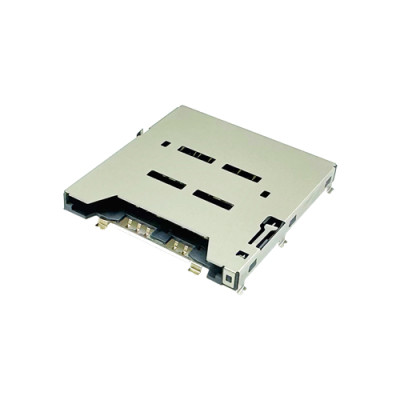
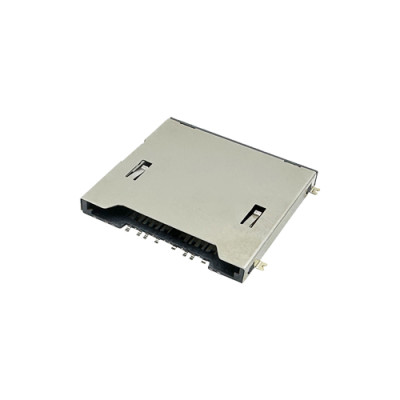
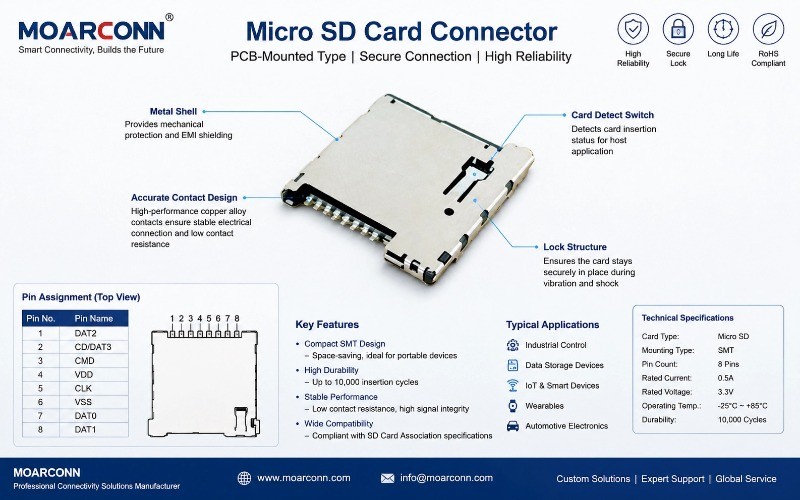
A Micro SD card connector is a PCB-mounted interface that mechanically holds a microSD card and electrically connects it with the system’s memory controller through carefully engineered contacts.
When a microSD card is inserted, gold-plated contact pads on the card align with corresponding contacts in the connector socket, allowing bidirectional data communication. The connector must maintain consistent electrical contact under repeated insertion cycles and varying environmental conditions.
Key operational factors include:
Contact reliability: Connector pins must sustain low and stable contact resistance throughout the product’s lifecycle.
Mechanical retention: Spring-loaded or push-pull mechanisms help ensure proper card retention without compromising ease of use.
2. Electrical Interface & Communication Basics
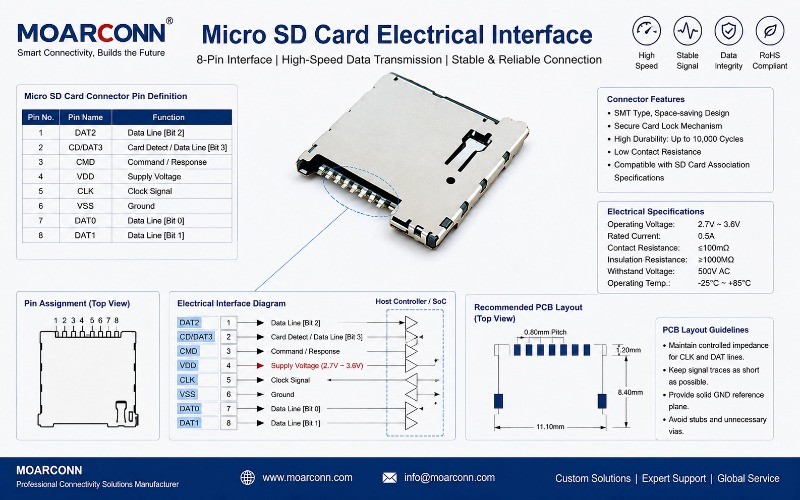
Micro SD cards operate based on standard communication protocols defined by the SD Association, including:
SPI Mode – Simple serial interface, often used in microcontrollers.
SD Bus Mode – Uses dedicated CMD, CLK, and DAT lines for higher throughput.
UHS / SD Express – Advanced modes for high-speed data transfer.
In each mode, the connector’s role is to provide consistent electrical coupling with minimal noise or reflection. A well-designed connector and PCB footprint ensure the correct signal pathway and reduce impedance discontinuities.
3. Why Signal Integrity Matters for Micro SD Connectors
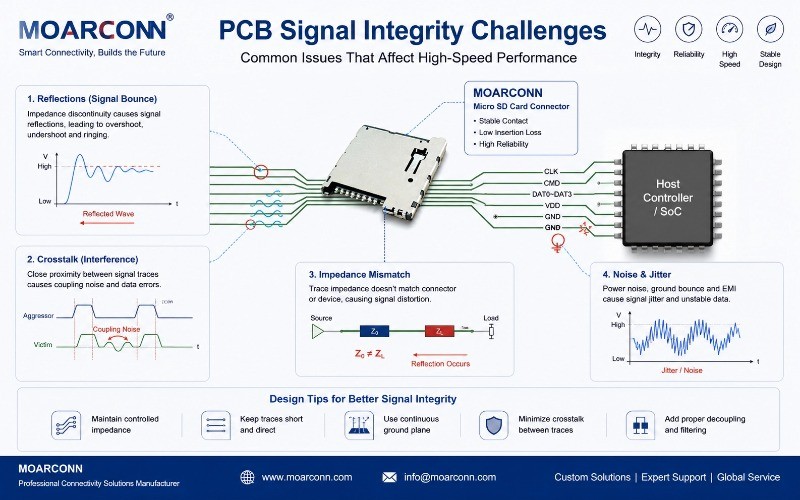
Signal integrity (SI) refers to the ability of an electrical signal to travel from one point to another without distortion, noise, or timing errors. It is a core consideration for high-speed digital interfaces.
High-speed data communication through Micro SD connectors requires careful engineering to avoid signal degradation caused by:
Impedance mismatches
Crosstalk between adjacent traces
Reflections due to discontinuities
Loss from connectors and vias
At clock speeds beyond basic SPI mode, these issues can become more pronounced and must be addressed during both mechanical and PCB design stages.
4. PCB Design Best Practices for Signal Integrity
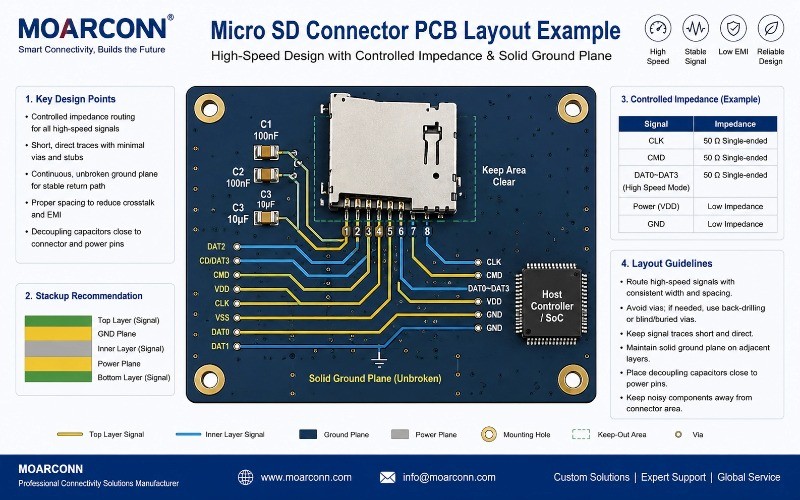
Engineering excellent signal integrity starts at the PCB layout phase. Consider these practical tips:
✔ Controlled Impedance Routing
Maintain consistent trace impedance from the micro SD connector pads through to the memory controller. Use 50 Ω controlled impedance traces and avoid abrupt changes in trace geometry.
✔ Ground Plane Continuity
A continuous ground plane beneath the signal traces helps provide stable return paths and reduces electromagnetic interference.
✔ Minimize Stub Length & Via Count
Each via and trace stub introduces parasitic capacitance and inductance that can degrade signal quality. Reducing them improves overall SI.
✔ Keep High-Speed Lines Short
Shorter routes minimize delay and reduce susceptibility to external noise and reflection, especially critical for high-speed SD modes.
This aligns with practical design recommendations found in PCB connector engineering resources.
5. Connector Selection – Engineering & Product Considerations
When choosing a Micro SD Card Connector, engineers should consider:
Insertion/Retention Force: Determines user experience and wear.
Durability cycles: Rated for thousands of insert/eject cycles.
Contact plating material: Gold is preferred for corrosion resistance and conductivity.
Environmental tolerance: Temperature, vibration, and humidity resilience.
💡 MoarConn Advantage:
MoarConn’s Micro SD Card Connectors are engineered with optimized contact springs, robust housings, and precision tolerances to deliver both high signal integrity and mechanical reliability across diverse applications — from consumer electronics to robotics and industrial platforms.
6. Testing & Verification for SI Compliance
Good engineering practice includes testing and simulation to verify signal integrity performance:
TDR (Time Domain Reflectometry): Checks impedance continuity.
Insertion loss measurements: Quantifies signal degradation.
Eye diagram analysis: Shows data integrity over time.
These tests help ensure that high-speed signals are not corrupted across the connector and PCB.
Conclusion: Engineering for Reliable Micro SD Interfaces
Micro SD Card Connectors play a vital role beyond just holding storage media — they are integral electrical components in the signal path. Engineers must combine mechanical understanding with signal integrity-oriented PCB design to achieve robust, high-performance systems.
By following established engineering practices and selecting quality components like those from MoarConn, you ensure both high reliability and long-term stability in your systems.