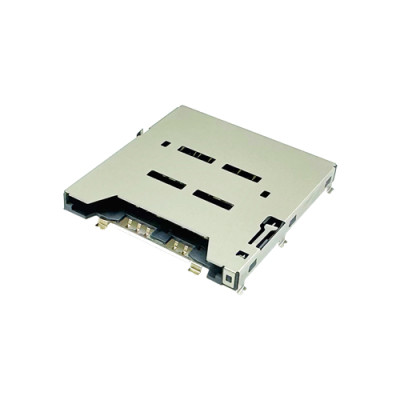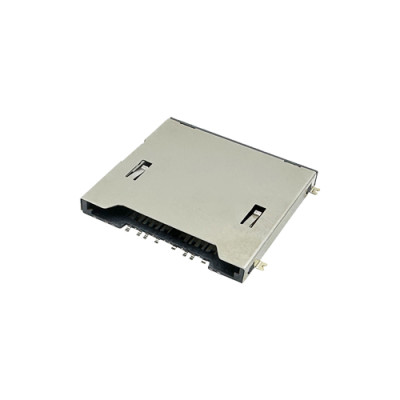
Why Your Next-Generation Intelligent Vehicle Needs a "Never-Disconnected" Connector?
In the era of software-defined vehicles, a high-end model generates more data daily than a medium-sized data center. From real-time map updates for L2+ assisted driving, to remote health monitoring of traction batteries, to in-car entertainment streaming, the cornerstone of all smart features relies on a seemingly small yet critically important component—the automotive SIM card connector.
Today, when we talk about "reliability," we mean far more than how long the connector itself can function. As pointed out in a recent article by industry authority Automotive IQ, cellular connectivity is now regarded as a "core safety system" as important as braking and steering. Once the connection is interrupted, the vehicle cannot receive OTA security updates, cloud-based AI driving models degrade, and the vehicle may even "become progressively less safe."
This means that choosing a SIM card connector for automobiles has evolved from a procurement task into a critical engineering decision concerning the safety and functional integrity of the vehicle throughout its entire lifecycle. This article delves into how the definition of "reliability" fundamentally changes when SIM card connectors move from consumer electronics into the harsh automotive environment, and how Moarconn, through precision design and rigorous testing, provides solutions that meet the demands of the next decade for our partners.
I. Consumer Grade vs. Automotive Grade: Fundamentally Different Environments
You might be familiar with this scenario: a smartphone's SIM tray occasionally sticks, and a reboot solves the problem. However, in a vehicle that travels on bumpy roads, experiences thermal cycles from -40°C to +125°C, and vibrates continuously for ten years, such "minor issues" are intolerable.
Characteristics of the Consumer Environment:
Design life is typically 2-3 years, falling into the "fast-moving consumer goods" category.
Operating environment is mild, primarily indoor or handheld, with relatively controllable temperature and humidity.
Primarily withstands occasional drop shocks, but no continuous vibration.
Failure consequences are usually limited to personal inconvenience or data loss.
Challenges of the Automotive Environment:
Must guarantee a service life of 10-15 years, making the connector a "lifetime component" of the vehicle; contacts must endure far more insertion/withdrawal cycles and fretting wear than usual.
Operating temperature range must reach -40°C to +125°C, while also withstanding harsh conditions like continuous vibration, salt spray, and electromagnetic interference. Connector materials (e.g., LCP housing) and gold-plated contacts must maintain dimensional stability and low contact resistance under extreme conditions.
Must pass vibration standards such as ISO 16750 and EN 60721-3-5 Class 5M3. Robust locking mechanisms (like Push-Pull self-latching structures) are essential to prevent the card from ejecting due to vibration.
Compliance with ISO 26262 functional safety standard is required; connection failure can directly lead to degradation of assisted driving functions or failure of safety updates, thus the connector itself is regarded as a "safety component."
II. Redefining "Reliability": From Physical Connection to System Safety
Automotive IQ's analysis profoundly points out that the in-vehicle SIM is not just an identification card; it is the physical starting point of the encrypted trust chain between the vehicle and the manufacturer's cloud. Therefore, the reliability of the connector is endowed with new meanings:
Anchor of "Permanent Identity": Automotive-grade SIMs (typically MFF2 or eSIM) establish a unique and persistent binding with the TCU (Telematic Control Unit) through the connector. The connector must ensure absolute stability of this electrical connection for 15 years. Any momentary interruption could lead to failure in security authentication between the vehicle and the cloud, preventing critical updates.
First Line of Defense in the "Attack Surface": The connector is part of the physical layer. A poorly designed connector might introduce electromagnetic leakage or become an entry point for physical tampering. Connectors compliant with the AEC-Q200 standard ensure signal integrity under electromagnetic interference, preventing external attacks from penetrating through the physical layer.
Bearer of "Functional Safety": For autonomous driving systems relying on cloud-based AI decisions, the real-time nature of data flow is mission-critical. The contact reliability of the connector directly impacts the real-time upload of data required for systems like Forward Collision Warning and Automatic Emergency Braking, as well as the download of model updates. The failure rate of the connector must be measured in PPB (parts per billion).
III. Moarconn's Engineering Practice: Born for Harshness
Facing the challenges above, Moarconn, when designing automotive SIM card connectors (such as our 115U Series), deconstructs "reliability" into quantifiable and verifiable engineering metrics, ensuring our products faithfully perform their duty as the "data cornerstone" throughout the vehicle's life.
Our Reliability Engineering:
Contact System Optimization: Utilizes multi-point contact and high-elasticity copper alloy to ensure contact resistance remains stable within the stringent range of Initial ≤50mΩ, After Test ≤100mΩ under intense vibration, far exceeding ordinary consumer-grade standards.
Environmental Resistance Materials: The housing uses high-temperature resistant, high-strength LCP plastic. Terminal plating thickness is increased to meet 15-year corrosion resistance requirements and passes 48-hour salt spray test without oxidation.
Mechanical Locking Structure: Targeting high-frequency automotive vibration, we have strengthened the Push-Pull self-latching mechanism, providing clear tactile feedback upon insertion and strong retention force, ensuring the SIM card and connector become one, undaunted by bumps.
Design Compatibility and Forward-Looking: We offer various specifications from Nano SIM (4FF) to Dual SIM/Micro SD 2-in-1, meeting space and signal integrity requirements from current 4G to future 5G and C-V2X modules. Additionally, for outdoor applications requiring IP67 waterproof ratings (e.g., construction machinery), we provide matching waterproof trays (e.g., 115U-T017) solutions.

Conclusion: Choosing the Right Connection for the Next Decade
When the intelligence of a vehicle worth hundreds of thousands depends on a connector measuring just a few square millimeters, this tiny component is no longer ordinary electronic material. It is the nerve ending of the software-defined vehicle, the bridge connecting the physical world and the digital cloud.
From consumer grade to automotive grade, we have redefined not only the product's specifications but also the assurance of our customers' safety commitment. Moarconn focuses on providing highly reliable connection solutions for automotive and industrial IoT. We deeply understand that every stable connection contributes to vehicle safety, user trust, and brand reputation.
If your next-generation onboard terminal, T-Box, or smart cockpit project is seeking a trustworthy SIM card connection partner, please contact Moarconn. Let us jointly define the high-reliability standard for future mobility.
About Moarconn
Moarconn is a high-tech enterprise specializing in the R&D and manufacturing of precision connectors. Our products are widely used in automotive electronics, industrial control, and IoT terminals. We possess extensive engineering experience in miniaturized, high-reliability connections and are committed to providing a "never-disconnected" connection experience for equipment in harsh environments.