Nano SIM Card Connectors for IoT, Automotive, and Industrial Devices: How to Design for Harsh Environments
Nano SIM Card Connectors for IoT, Automotive, and Industrial Devies: How to Design for Harsh Environments
When an IoT gateway, vehicle telematics system, industrial controller, or tracking device loses cellular connectivity, engineers often look first at the modem, antenna, firmware, or network.
But there is another component that deserves attention: the Nano SIM Card Connector.
A SIM connector is a small electromechanical interface, but its mechanical and electrical performance can directly affect the stability of the connection between the Nano SIM card and the cellular communication system. In applications exposed to vibration, mechanical shock, temperature changes, humidity, or repeated servicing, connector selection becomes a system-reliability consideration rather than simply a packaging decision.
For engineers designing connected products, the key question is therefore not simply:
“Does this connector support a Nano SIM card?”
It is:
“Can this Nano SIM Card Connector maintain reliable mechanical and electrical contact throughout the intended life of the product?”
This guide explains the major design considerations for Nano SIM Card Connectors in IoT, automotive, and industrial applications, with particular attention to harsh-environment requirements.
1. What Is a Nano SIM Card Connector?
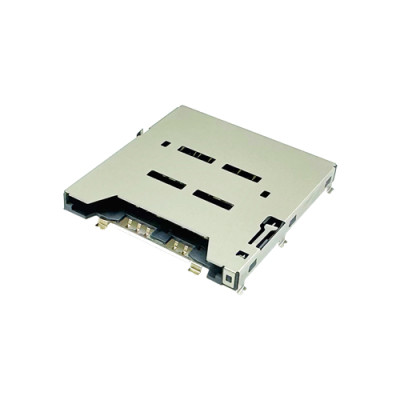
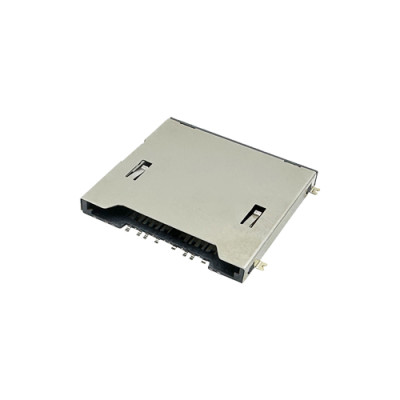
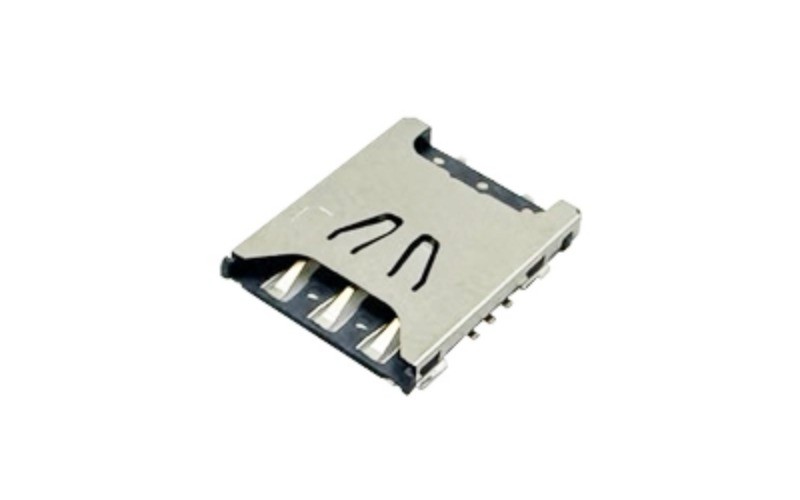
A Nano SIM Card Connector, also called a Nano SIM socket or Nano SIM card holder, provides the mechanical and electrical interface between a Nano SIM card and the host PCB.
Nano SIM cards use the 4FF form factor. Moarconn's Nano SIM connector portfolio is designed around this compact card format and includes different mounting and ejection configurations for different product architectures.
A typical Nano SIM connector performs several functions:
Holds the SIM card in the correct position
Provides electrical contact between the SIM card and PCB
Supports card insertion and removal
Maintains contact force during operation
Prevents unwanted card movement
Integrates with the device's mechanical enclosure
May provide card-detection functionality
The connector therefore sits at the intersection of mechanical design, electrical design, PCB layout, manufacturing, and user interaction.
Engineer's Note
A common mistake is to select a connector based only on the Nano SIM card dimensions.
In practice, engineers should also evaluate:
Connector height
PCB footprint
Mounting method
Ejection mechanism
Contact configuration
Contact material and plating
Insertion/extraction cycles
Operating temperature
Vibration and shock requirements
Card retention
Enclosure integration
Manufacturing process
The connector should be selected as part of the complete device architecture.
2. Why Nano SIM Card Connectors Matter in IoT, Automotive, and Industrial Devices
Nano SIM technology is particularly useful when designers need cellular connectivity in a compact device.
Applications can include:
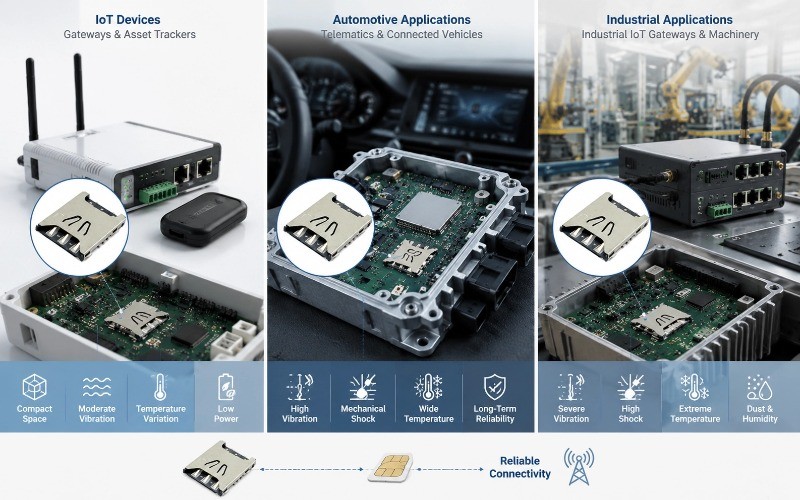
IoT gateways
Asset trackers
GPS tracking devices
Smart meters
Industrial gateways
Fleet-management equipment
Automotive telematics
Connected vehicle systems
V2X equipment
Security and surveillance devices
M2M equipment
Communication terminals
Industry product examples also show Nano SIM connectors being designed for applications such as telematics, V2X, IIoT, smart meters, gateways, routers, and M2M equipment.
The important engineering difference is that these applications do not all impose the same environmental requirements.
A wearable device may prioritize minimum height and compactness.
An industrial gateway may prioritize mechanical stability and long service life.
An automotive telematics device may have to consider temperature, vibration, shock, and long-term contact reliability.
This is why there is no single “best” Nano SIM Card Connector for every application.
3. What Makes an Environment Harsh for a Nano SIM Connector?
A harsh environment is not defined by one parameter.
For Nano SIM Card Connectors, engineers should consider the combination of mechanical, thermal, electrical, and environmental stresses.
3.1 Vibration
Vibration is particularly important in:
Vehicles
Fleet-management systems
Industrial machinery
Robotics
Construction equipment
Industrial IoT equipment
Continuous vibration can create small relative movements between mating surfaces. Over time, these movements can contribute to contact wear, contamination, or changes in electrical contact stability.
A connector designed for a consumer device should therefore not automatically be assumed to be suitable for a high-vibration application.
3.2 Mechanical Shock
A vehicle hitting a pothole, industrial equipment being moved, or a portable device being dropped can expose the connector to sudden mechanical acceleration.
The design should consider:
Card retention
Tray locking
Contact stability
Housing strength
PCB attachment
Mechanical support
Some industrial-oriented Nano SIM connector designs are specifically tested for vibration and shock. For example, ATTEND describes its 115U-A101 as being tested against EN 60721-3-5 Class 5M3 vibration and shock requirements.
Important: Such test results belong to the referenced product and should not be generalized to every Nano SIM connector.
3.3 Temperature
Temperature is another important design parameter.
Automotive and industrial devices may experience much wider temperature conditions than indoor consumer products.
Temperature changes can affect:
Housing materials
Contact materials
Mechanical tolerances
Contact force
Solder joints
Long-term material stability
JAE, for example, describes its SF72 Nano SIM connector series as being evaluated against automotive specifications, including high-temperature environments up to 125°C.
Again, engineers should always verify the actual operating and storage temperature specifications of the selected component rather than assuming that one connector's rating applies to another.
3.4 Humidity and Corrosion
Humidity can become a reliability concern when conductive surfaces are exposed to moisture or corrosive environments.
Relevant considerations include:
Contact material
Plating
Housing material
Environmental sealing
Enclosure design
Corrosive contaminants
The connector should be evaluated together with the device enclosure rather than treated as an isolated component.
3.5 Dust and Contamination
Industrial equipment may operate in environments containing:
Dust
Particles
Oil
Moisture
Chemical contaminants
Contamination around the card-contact interface can potentially affect electrical contact.
Where environmental protection is required, engineers should evaluate the connector together with the tray, enclosure, gasket, and overall mechanical architecture.
4. How Harsh Environments Affect Nano SIM Connector Reliability
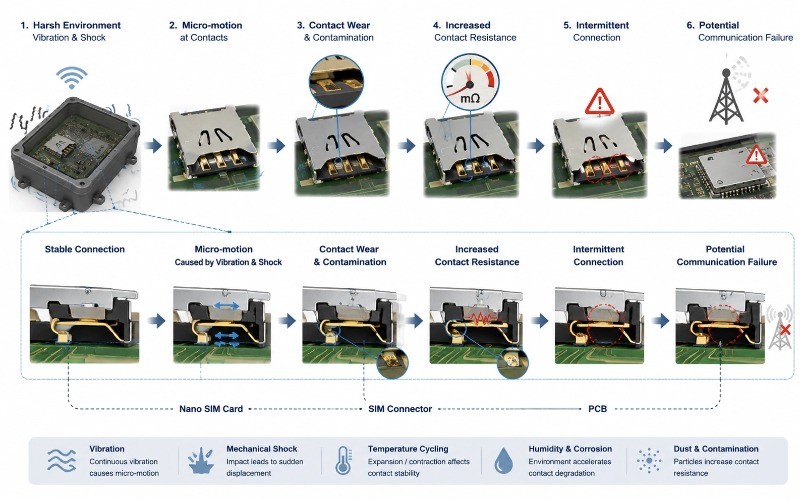
The relationship between environment and connector reliability can be summarized as:
Environmental stress → mechanical movement → contact degradation → electrical instability → potential communication failure
For example:
Vibration
↓
Micro-motion between contact surfaces
↓
Contact wear / contamination
↓
Increased contact resistance or intermittent contact
↓
Potential SIM communication instability
This is why mechanical design is an important part of electrical reliability.
Engineer's Note
The cellular modem may be functioning correctly.
The SIM card may also be functioning correctly.
Yet the system can still experience intermittent communication if the physical interface between them becomes unstable.
For this reason, Nano SIM connector reliability should be considered during the early product-design stage rather than after a field failure occurs.
5. Key Nano SIM Card Connector Design Considerations
5.1 Contact Force
Contact force must be sufficient to maintain electrical contact while remaining appropriate for the SIM card and connector mechanism.
Too little force may increase the risk of intermittent contact.
Excessive force may increase:
Card insertion force
Contact wear
Mechanical stress
User difficulty during card removal
The correct design is therefore a balance between electrical reliability and mechanical usability.
5.2 Contact Material and Plating
Contact material and surface finish influence:
Contact resistance
Corrosion resistance
Wear resistance
Long-term stability
Gold-plated contact systems are commonly used where stable electrical contact and corrosion resistance are important, but engineers should evaluate the actual material and plating specification of the selected connector
5.3 Card Retention
For industrial and automotive applications, card retention deserves particular attention.
The connector should prevent unintended movement caused by:
Vibration
Shock
Device movement
Thermal expansion
Improper assembly
A locking tray or other retention mechanism can help maintain the card's position.
ATTEND's industrial-oriented Nano SIM design, for example, combines a tray locking structure with vibration and shock resistance.
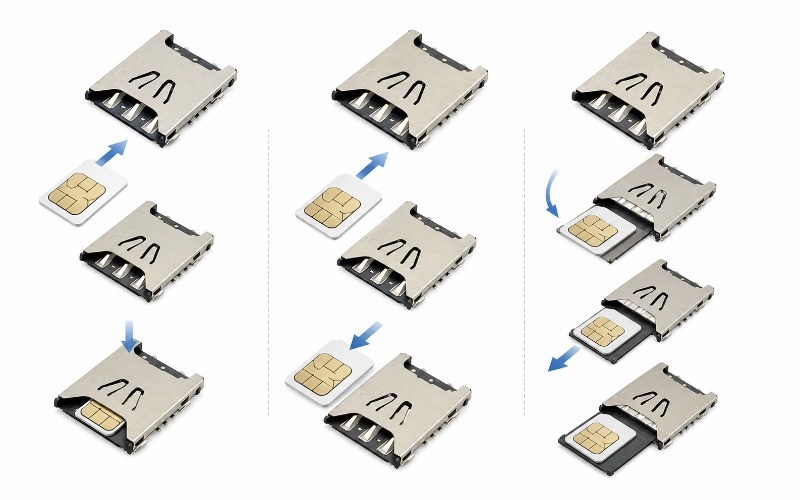
5.4 Push-Push vs. Push-Pull vs. Hinged/Tray
The ejection mechanism influences both product usability and mechanical architecture.
Push-Push
The user pushes the card/tray to insert it and pushes again to eject it.
Potential advantages:
Compact user interface
Convenient operation
Suitable for embedded designs
Push-Pull
The card or tray is pushed into the connector and pulled out during removal.
Potential advantages:
Simple operating concept
Flexible mechanical integration
Useful for certain embedded applications
Hinged / Tray Type
The SIM card is inserted into a hinged or removable tray.
Potential advantages:
Clear card positioning
Convenient handling
Flexible enclosure integration
Moarconn's current Nano SIM portfolio includes Push-Pull, Push-Push, Hinge, and Tray configurations, allowing engineers to match the connector mechanism to their mechanical architecture.
6. IoT vs. Automotive vs. Industrial Nano SIM Connector Requirements
The same Nano SIM form factor can be used in very different environments.
| Design Requirement | IoT | Automotive | Industrial |
High | High | High | Medium–High |
| Low profile | High | High | Medium |
Vibration resistance | Medium–High | Very High | High |
Shock resistance | Medium | Very High | High |
Temperature range | Application-dependent | High priority | High priority |
Card retention | High | Very High | Very High |
Insertion durability | Medium–High | Medium–High | High |
Corrosion resistance | Application-dependent | High | High |
| Easy serviceability | Medium–High | Medium | High |
| Custom mechanical design | Often useful | Often useful | Often useful |
Engineer’s conclusion: The connector should be selected according to the actual application environment rather than simply according to the SIM card format.
7. Nano SIM Card Connector Design for IoT Devices
IoT products often impose two apparently conflicting requirements:
Small size + long-term reliability.
Examples include:
Asset trackers
GPS trackers
Smart meters
IoT gateways
Remote monitoring systems
Smart security equipment
M2M devices
In these products, engineers may need to optimize:
PCB Space
Every millimeter can matter.
A low-profile Nano SIM connector can help reduce the overall PCB and enclosure height.
Mechanical Stability
A small connector still needs sufficient retention and contact stability.
Serviceability
Some industrial IoT products may require SIM replacement during maintenance.
Environmental Protection
Outdoor or semi-outdoor equipment may require the SIM connector to be considered as part of the overall enclosure protection strategy.
8. Nano SIM Card Connectors for Automotive Applications
Automotive electronics place particular demands on connector design.
Connected vehicle applications can include:
Telematics
Fleet management
V2X
Vehicle tracking
Infotainment
Wireless communication systems
Connected vehicle gateways
JAE's SF72 series illustrates the trend toward Nano SIM connectors being evaluated for automotive requirements, including high-temperature operation.
For automotive designs, engineers should consider:
Temperature
Evaluate both operating and storage temperatures.
Vibration
Consider the vibration profile of the actual installation location.
Mechanical Shock
Evaluate card retention and connector mechanical stability.
Long-Term Reliability
The connector may remain installed for years, making stable contact performance important.
Packaging
The connector needs to integrate with the vehicle's PCB, housing, service strategy, and available space.
9. Nano SIM Card Connectors for Industrial Devices
Industrial applications can be especially demanding because equipment may operate continuously for years.
Typical applications include:
Industrial gateways
Automation equipment
Remote monitoring systems
Smart meters
Security systems
Industrial communication equipment
IIoT equipment
In these applications, engineers should prioritize:
Mechanical retention
Vibration resistance
Shock resistance
Temperature performance
Contact reliability
Insertion durability
PCB attachment strength
Environmental compatibility
The goal is not simply to make the SIM card fit.
The goal is to ensure that the SIM-to-PCB interface remains stable throughout the expected product life.
10. PCB Design Considerations for Nano SIM Card Connectors
Selecting the right connector is only the first step.
The PCB layout also affects mechanical and electrical reliability.
10.1 Follow the Manufacturer's Footprint
Always use the latest:
PCB footprint
Mechanical drawing
Recommended land pattern
3D CAD model
Assembly recommendations
Do not recreate connector footprints from photographs.
10.2 Check Connector Height
Connector height affects:
Enclosure clearance
Adjacent components
Internal mechanical structures
PCB stacking
Overall product thickness
10.3 Maintain Mechanical Clearance
Leave sufficient space around:
Card insertion path
Tray
Ejection mechanism
Adjacent components
Housing walls
10.4 Consider PCB Mechanical Stress
The connector may experience mechanical forces during:
Card insertion
Card removal
Product assembly
Field servicing
The PCB and solder joints should therefore be considered as part of the mechanical load path.
MoarConn provides CAD and engineering support as part of its connector development approach, helping engineers evaluate connector selection and PCB integration earlier in the design process.
11. Nano SIM Connector Reliability Testing
Testing should reflect the actual application.
Potential evaluation areas include:
Mechanical Testing
Insertion/extraction cycles
Card retention
Tray operation
Mechanical shock
Vibration
Environmental Testing
High temperature
Low temperature
Temperature cycling
Humidity
Corrosion resistance where applicable
Electrical Testing
Contact resistance
Insulation resistance
Dielectric withstand
Electrical continuity
Manufacturing Validation
SMT solderability
Reflow compatibility
AOI inspection
PCB assembly robustness
The exact test methods and acceptance criteria should be established according to the product specification, applicable standards, customer requirements, and connector manufacturer's datasheet.
12. Common Nano SIM Connector Failure Modes
| Failure Mode | Possible Cause | Engineering Consideration |
| Intermittent SIM connection | Unstable contact | Check contact force and card retention |
SIM not detected | Detection switch or contact issue | Verify mechanical and electrical interface |
Card movement | Insufficient retention | Verify material and operating range |
Connector damage | Excessive insertion force | Review insertion mechanism |
Solder joint failure | PCB/mechanical stress | Review footprint and mechanical support |
Contact wear | Excessive mating cycles | Select appropriate durability rating |
Corrosion | Humidity/contamination | Review material, plating, and enclosure |
Thermal reliability issue | Temperature cycling | Verify material and operating range |
13. How to Select the Right Nano SIM Card Connector
Before approving a connector for production, engineers can use the following checklist.
Mechanical
☐ Nano SIM / 4FF compatibility
☐ Connector height
☐ PCB footprint
☐ Mounting direction
☐ Push-Push / Push-Pull / Hinge / Tray
☐ Card retention
☐ Ejection force
☐ Insertion/extraction cycles
Electrical
☐ Contact configuration
☐ Contact resistance
☐ Current rating
☐ Voltage rating
☐ Insulation resistance
☐ Detection switch requirements
Environmental
☐ Operating temperature
☐ Storage temperature
☐ Vibration
☐ Mechanical shock
☐ Humidity
☐ Corrosion
☐ Dust/water exposure
Manufacturing
☐ SMT compatibility
☐ Reflow profile
☐ PCB footprint availability
☐ 3D CAD model
☐ Inspection requirements
☐ Production availability
Product Lifecycle
☐ Prototype availability
☐ Qualification testing
☐ Supply capability
☐ Customization capability
☐ Technical support
☐ Long-term production support
14. Why Work With Moarconn for Nano SIM Card Connectors?
Choosing a connector manufacturer is not only about finding a component that fits the PCB.
For OEM and ODM projects, engineering support can be equally important.
Moarconn focuses on the R&D, manufacturing, sales, and service of card connectors, with more than 20 years of experience in connector-related development and precision tooling. Its product scope includes SD, Micro SD, SIM, and Smart Card connectors.
For Nano SIM applications, Moarconn offers multiple connector configurations, including:
Push-Push Nano SIM connectors
Push-Pull Nano SIM connectors
Hinge-type Nano SIM connectors
Tray-type Nano SIM connectors
Low-profile designs
Different mounting configurations
Its current Nano SIM portfolio includes products with different heights and mechanisms, giving engineers more options when balancing PCB space, mechanical requirements, and usability.
Engineering Support From Prototype to Production
Moarconn's manufacturing model covers more than component supply.
The company states that it can provide one-stop support covering:
Design → Mold Making → Product Assembly → After-Sales Service
This can be particularly valuable when a standard Nano SIM connector does not perfectly match the PCB, enclosure, operating environment, or mechanical requirements of a new product.
Customized Nano SIM Connector Solutions
A customized connector may be worth evaluating when your design requires:
Non-standard dimensions
Special mounting geometry
Specific connector height
Custom tray structure
Special card-retention requirements
Additional detection functionality
Mechanical integration with a custom enclosure
A replacement for an existing connector
Moarconn's website specifically highlights personalized customization and engineering support for card connector projects.
15. Standard vs. Customized Nano SIM Card Connectors
Not every project requires customization.
Choose a Standard Connector When:
The PCB footprint already matches
The required height is available
Standard insertion mechanisms are acceptable
Environmental requirements are within the product specification
Production volume and supply requirements are straightforward
Consider Customization When:
Space is extremely limited
The enclosure requires a special mechanical interface
The standard connector cannot meet the required height
Card access must be positioned differently
Special retention is required
The connector must integrate with an existing housing
A brand-replacement or second-source solution is required
For OEM and ODM teams, evaluating customization early can prevent expensive mechanical redesign later.
16. Engineer's Design Rule: Select the Connector Before the PCB Is Frozen
One of the most practical lessons for hardware engineers is simple:
Do not wait until the PCB layout is finished to select the Nano SIM connector.
The connector affects:
PCB footprint
Board height
Enclosure design
Card insertion direction
Component clearance
Assembly process
Mechanical reliability
Serviceability
Moarconn's own engineering guidance recommends validating the connector early during the DFM/prototype stage and using supplier CAD models and layout information to reduce redesign risk.
A better development workflow is:
Application requirements
↓
Environmental requirements
↓
Connector mechanism
↓
Mechanical drawing
↓
PCB footprint
↓
Prototype
↓
Reliability testing
↓
DFM
↓
Mass production
17. Nano SIM Card Connector Selection: Final Checklist
Before releasing your design, ask these questions:
Application
Where will the device operate?
Is it stationary or mobile?
Will the device experience vibration?
Will it experience mechanical shock?
Environment
What is the actual operating temperature range?
Is humidity a concern?
Is the device exposed to dust or contaminants?
Is corrosion resistance required?
Mechanical
What connector height can the enclosure accommodate?
Which ejection mechanism is appropriate?
How will the card be retained?
How often will the SIM be replaced?
Electrical
What contact configuration is required?
Is card detection needed?
What contact resistance is acceptable?
What electrical reliability is required?
Manufacturing
Is the connector SMT compatible?
Has the PCB footprint been verified against the latest drawing?
Has the connector been evaluated through the intended reflow process?
Are samples available for prototype testing?
Reliability
Has vibration testing been considered?
Has shock testing been considered?
Has temperature cycling been considered?
Have insertion/extraction cycles been validated?
If these questions are answered before design freeze, the probability of late-stage connector redesign can be significantly reduced.
18. Conclusion
A Nano SIM Card Connector may be a small component, but it can have an outsized impact on the reliability of connected devices.
For IoT, automotive, and industrial products, engineers should look beyond basic card compatibility and evaluate the complete system:
Card format + connector mechanism + contact design + card retention + PCB layout + enclosure + environmental conditions + reliability testing.
For harsh environments, particular attention should be given to:
Vibration
Mechanical shock
Temperature
Humidity
Corrosion
Contact stability
Card retention
Insertion durability
PCB and solder-joint reliability
There is no universal connector that is ideal for every application. The right Nano SIM Card Connector is the one whose mechanical, electrical, environmental, and manufacturing characteristics match the actual requirements of the finished product.
For engineers developing IoT gateways, automotive telematics, industrial communication equipment, tracking devices, and other connected products, Moarconn provides a range of Nano SIM connector configurations as well as customization and engineering support for application-specific requirements.
Need help selecting a Nano SIM Card Connector for your next project? Contact Moarconn's engineering team to discuss your PCB, mechanical, environmental, and production requirements.
About Moarconn
Moarconn is a card connector manufacturer focused on SD, Micro SD, SIM, and Smart Card connector solutions. With more than 20 years of experience in connector development and precision tooling, Moarconn supports customers from design and mold development through product assembly and after-sales service.
For more information about Nano SIM Card Connectors and customized connector solutions, visit Moarconn.