Nano SIM Connector: Design Tips Every Engineer Should Know
Nano SIM Connector: Design Tips Every Engineer Should Know
Optimize your next-generation device with reliable, space-efficient Nano SIM connector solutions and expert engineering insights.
Introduction: Why Nano SIM Connector Design Matters
In today’s ultra-compact electronics — from premium smartphones to rugged IoT devices — the Nano SIM connector plays a critical role in ensuring reliable cellular connectivity. Although small in size, the connector impacts device thickness, contact stability, insertion/re-ejection reliability, and overall user experience.
Understanding design principles early in the development cycle helps engineers avoid costly redesigns and ensures long-term product performance.
At Moarconn, we specialize in high-quality Nano SIM connectors tailored to modern smart devices and industrial applications, backed by 20+ years of connector expertise.
What Is a Nano SIM Connector?
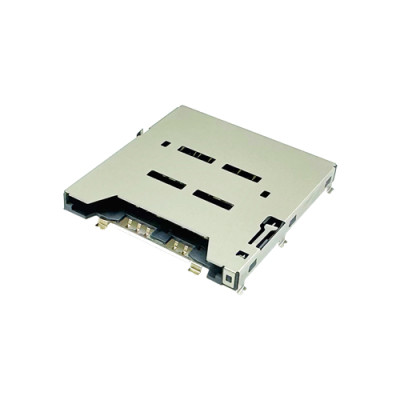
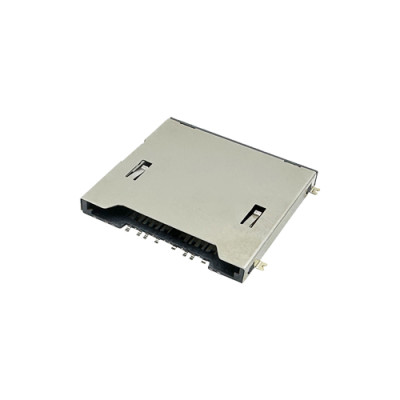
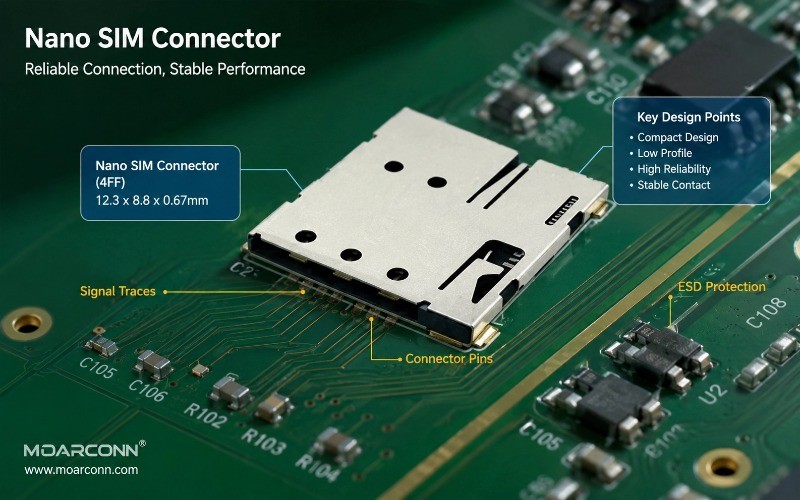
A Nano SIM connector is the smallest form factor (4FF) interface used to hold and connect a Nano SIM card (12.3 × 8.8 × 0.67 mm) to a PCB modem or controller. Compared to larger SIM connectors, Nano SIM connectors offer:
Minimal footprint and low profile height
Strong mechanical retention
Stable electrical contacts for cellular communication
This form factor is essential for ultra-thin designs like wearables, smart devices, and embedded systems.
Key Design Tips for Nano SIM Connectors
1. Choose the Right Form Factor & Mounting Style
There are multiple Nano SIM connector styles — each suited for different design constraints:
Push-Push: Self-ejecting mechanism for internal slots
Push-Pull: Simple structure with reliable ejection
Tray or Hinged: Suitable for external access and sealed enclosures
Choosing the right type depends on device access, thickness requirements, and user interaction design.
2. Mechanical Durability & Insertion Cycles
Nano SIM connectors must withstand frequent SIM card insertion and removal. Typical ratings include:
Consumer devices: ≥5,000 insertion cycles
Industrial applications: ≥10,000 or more
At Moarconn, industrial-grade connectors use high-elastic copper alloy contacts and optimized gold plating to maintain stable contact force even after repeated use.
Engineering Tip: Always review the rated insertion cycle for your connector choice and match it with your expected product usage. More cycles help reduce field failures.
3. Contact Reliability & Material Selection
Reliable electrical contact is essential for uninterrupted cellular communication. Design considerations include:
Gold-plated contacts for corrosion resistance
Contact force optimization for vibration resistance
LCP housing materials for temperature and mechanical stability
These materials ensure connectors perform well in harsh environments including automotive and industrial IoT.
4. Connector Height & PCB Footprint
In ultra-slim devices, connector height and board footprint are key constraints:
Low profile designs reduce total device thickness
Compact footprints free PCB area for other critical components
Moarconn offers Nano SIM connectors with ultra-low heights (e.g., 1.10 mm and 1.25 mm series) that strike an ideal balance between mechanical strength and space-efficient design
5. Card Detection & Environmental Considerations
Designers should integrate card detection switches and prepare for environmental stresses:
Card presence detection helps firmware detect SIM card insertion
Temperature range tolerance (e.g., –40 °C to +85 °C)
Resistance to vibration, humidity, and dust
These features are particularly important in wearables and industrial systems requiring reliable performance over time.
Best Practices for PCB Integration
Successful PCB integration avoids layout pitfalls and ensures reliability.
Engineers should:
Place SIM connector near PCB edge for accessibility
Minimize trace lengths between SIM connector and cellular module
Avoid placing high-frequency circuitry too close to prevent interference
Add ESD protection devices close to the SIM connector’s signal lines
Early collaboration between mechanical and electrical designers helps prevent layout issues later in development.
Why Choose Moarconn Nano SIM Connectors
As your trusted partner in connector solutions, Moarconn delivers:
A full range of high-performance Nano SIM connectors
Customization options including height, plating, and detection switch
Comprehensive CAD models, datasheets, and engineering support
Stable supply and global distribution
We support design engineers throughout the entire product lifecycle — from prototype to mass production.
Application Scenarios
Nano SIM connectors are widely used in:
Smartphones & Wearables
NB-IoT & LTE-M modules
Industrial & Rugged devices
Automotive Telematics and GPS Trackers
Choosing the right connector optimizes signal quality, durability, and user experience across applications.
Conclusion
The Nano SIM connector — though small — has a significant impact on device reliability and product success. By understanding form factor choices, mechanical considerations, electrical reliability, and PCB design integration, engineers can optimize performance and expedite time-to-market.
For expert support on Nano SIM connector design or to request samples, visit Moarconn at www.moarconn.com.