The Ultimate Selection Guide: How to Choose the Right SD Card Socket for Your Industrial Device
In the era of rapid advancement in smart manufacturing, the Industrial Internet of Things (IIoT), and autonomous driving, industrial equipment has evolved beyond mere production tools into intelligent terminals that continuously generate and analyze vast amounts of data. As the carrier for this critical data, the reliability and durability of SD cards (including MicroSD cards) are of paramount importance. However, a frequently overlooked core component—the SD Card Socket Connector—often directly determines the success or failure of data storage.
Industrial-grade vibrations, temperature and humidity fluctuations, dust, and frequent insertion/removal cycles pose fatal threats to standard sockets. A single poor contact may lead to the loss of critical production logs; a socket with inadequate sealing could cause an entire outdoor device to fail prematurely due to dust ingress.
This guide aims to provide a comprehensive, professional selection guide for industrial-grade SD card sockets. We will go beyond simple parameter listings, approaching the topic from three dimensions: engineering design, application scenarios, and long-term reliability. Integrating authoritative industry insights and cutting-edge manufacturing experience, we aim to help you choose the sturdiest and most reliable "data gateway" for your equipment.
Part 1: Core Concepts and the Particularities of Industrial Applications
Before diving into selection, we must understand that the value of an industrial-grade SD card socket far exceeds merely "holding a card."
1.1 Core Challenges for SD Card Sockets in Industrial Equipment
Referencing insights from industry analyses, industrial storage components must withstand the following harsh environments:
Extreme Temperatures: Equipment may operate in -40°C frigid zones or within +85°C hot chassis. Materials expand and contract, standard plastics can become brittle, and the properties of metal contacts can alter.
Constant Vibration and Shock: Continuous vibrations from factory machine tools, engineering machinery, and vehicles can cause microscopic, instantaneous disconnections between the card and socket, leading to data errors or failures.
Dust and Moisture: Dust from production floors or moisture from outdoor rain may invade the socket interior, causing short circuits or oxidative corrosion.
Long-term Reliability and Lifespan: Industrial equipment often has lifecycles of 5-10 years or more. Sockets must maintain good contact through tens of thousands of insertion/removal cycles, and the supply chain must be stable to support long-term availability.
1.2 Why an "Industrial-Grade" Socket is Non-Negotiable
Consumer-grade sockets prioritize functionality, whereas the design goal of industrial-grade sockets is "guaranteed flawless functionality under adverse conditions." This embodies a combination of materials science (e.g., high-temperature LCP plastic, thick gold plating on contacts), mechanical design (e.g., shockproof latches, reinforced terminals), and stringent quality control (e.g., Automated Optical Inspection). Choosing an industrial-grade socket is a crucial investment in your product's long-term reputation and the asset security of your end customers.
Part 2: Analyzing Industrial SD Card Socket Selection Across Five Core Dimensions
systematic evaluation, much like choosing a core chip. We summarize five key dimensions based on industry information:
Core Dimension 1: Mechanical Structure Type – Determining the Foundation of Reliability
This is the primary decision point in selection, directly related to the installation method and long-term stability.
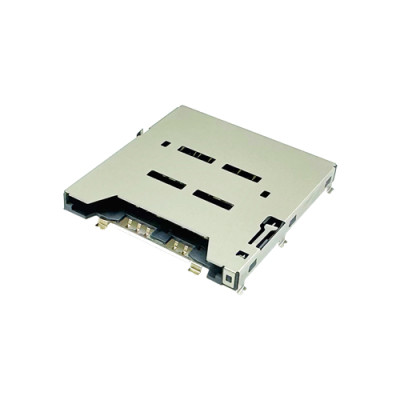
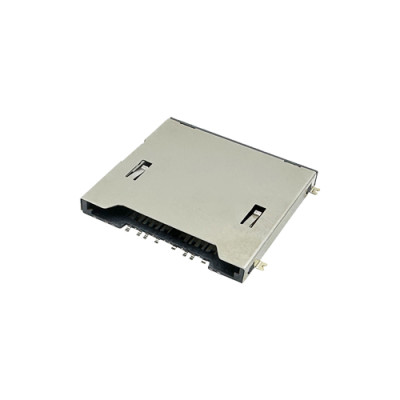
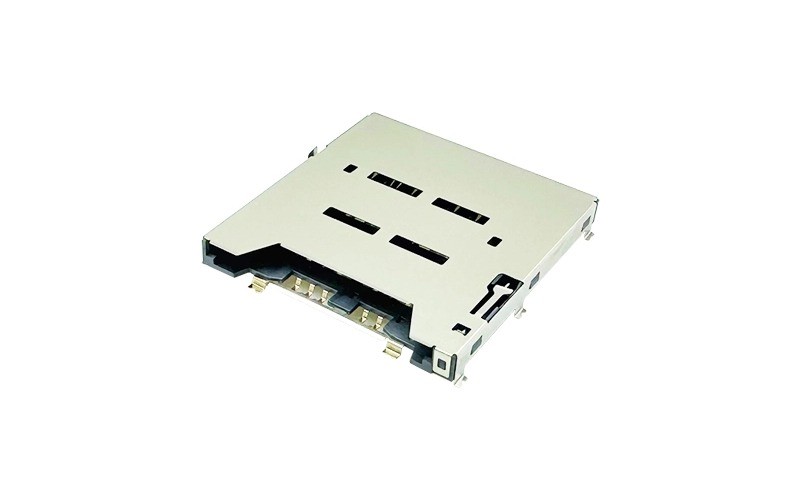
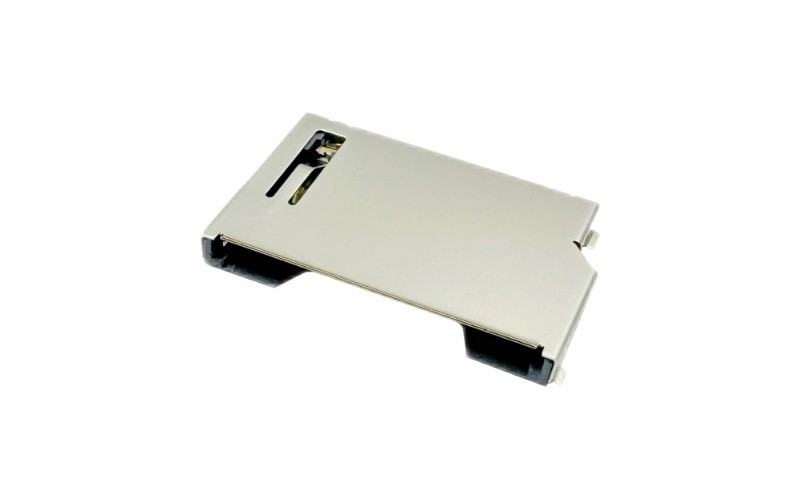
Soldered (Surface-Mount) Socket:
Structure & Principle: The main body of the socket is directly soldered to the PCB via multiple pins, forming an extremely robust mechanical and electrical connection.
Advantages: Excellent shock resistance, simple structure, highest reliability, often more cost-effective.
Disadvantages: Difficult to replace if damaged; inserting/removing the card requires direct handling of the card itself.
Typical Applications: Industrial control equipment, security surveillance, vehicle recorders, network communication devices—applications sensitive to vibration, with infrequent card changes, or designed for long-term embedded operation.
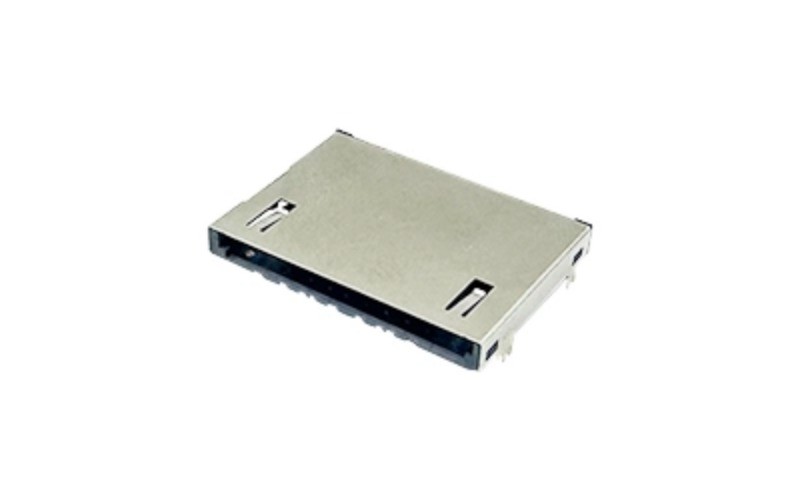
Push-Push Eject Socket:
Structure & Principle: Incorporates a precision spring and slider mechanism; a press ejects the card.
Advantages: Excellent user experience, convenient insertion/removal, protects the card's gold fingers.
Disadvantages: More complex structure, higher cost; the spring mechanism may pose a failure risk in high-vibration environments.
Typical Applications: Portable testing instruments, handheld terminals, consumer-grade industrial equipment—scenarios requiring frequent card replacement.
Core Dimension 2: Environmental Durability – The Test of Materials and Craftsmanship
This is the most direct reflection of the "industrial-grade" label and must be carefully checked in the datasheet.
Operating Temperature Range: Must explicitly support the industrial wide-temperature standard of -40°C to +85°C. This requires housing plastics that do not become brittle at low temperatures nor deform at high temperatures.
Protection Level:
Dust Resistance: Check if the socket has a dust cover or labyrinth design to prevent dust from entering the contact area.
Splash Resistance: Some high-end sockets offer certain sealing capabilities to handle accidental liquid splashes.
Durability: Insertion/removal cycle life is a key metric. Industrial-grade sockets should achieve 5,000 to 10,000 cycles, with contact resistance variation within allowable limits. This depends on high-elasticity, fatigue-resistant gold-plated alloy contact springs.
Core Dimension 3: Electrical Performance & Compatibility – Ensuring Speed and Stability
The essence of a connector is a signal pathway; electrical performance cannot be compromised.
High-Speed Transfer Support: Confirm if the socket supports UHS-I, UHS-II, or even UHS-III standards based on device requirements. Higher-speed protocols demand more from contact spacing and signal integrity.
Contact Resistance & Current: Low and stable contact resistance (typically required to be within a few tens of milliohms) is fundamental for stable power supply and data signal integrity.
Compatibility & Standards: Ensure the socket adheres to the latest SD physical specification standards and is compatible with industrial-grade memory cards from different brands and thicknesses.
Core Dimension 4: Installation & PCB Design – A Systems Engineering Approach to Reliability
The reliability of a socket depends half on itself and half on how it is correctly integrated into the device.
Installation Method: Beyond common Surface-Mount Technology (SMT), for high-vibration environments, consider sockets with through-hole or screw mounting posts for additional mechanical strength.
PCB Land Pattern & Layout Design: Strictly follow the manufacturer's recommended land pattern for Layout. Sufficient grounding and proper protection for high-speed signal lines are key to avoiding interference.
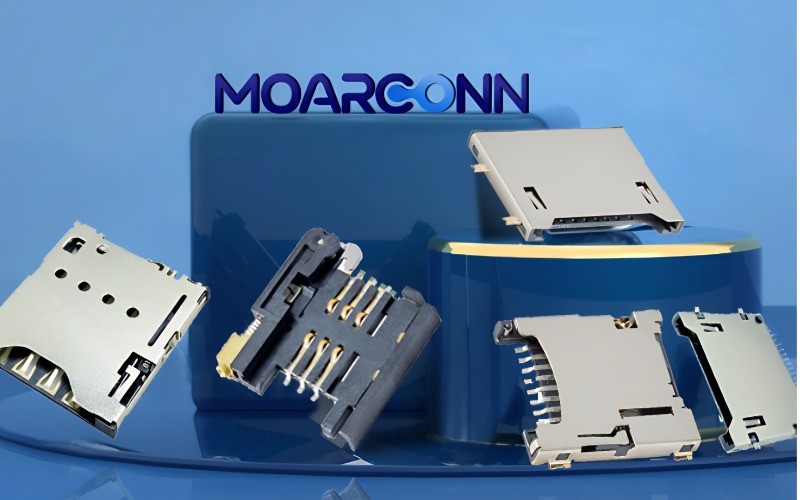
MOARCONN Customization Insight: With over 20 years of experience as a connector manufacturer, MOARCONN deeply understands that successful industrial design requires early collaboration. We not only provide standard products but excel in offering Design-in support. When a customer has only a concept or sample, our engineering team can quickly engage to help optimize PCB layout and socket selection, preventing后期故障 caused by design flaws. This is the core of our "technical partnership" service.
Core Dimension 5: Supply Chain & Customization Capability – The Backbone of the Product Lifecycle
Industrial products have long lifecycles; selection must take a long-term perspective.
Long-Term Supply Commitment: Choose manufacturers like MOARCONN that can provide stable long-term supply, avoiding the risk of critical component shortages due to product iterations.
Customization Capability: Standard products cannot meet all needs. A professional manufacturer should offer:
Dimensional Customization: To fit special internal device spaces.
Interface Customization: Such as special pin definitions, adding detection switches.
Material & Process Customization: Such as higher protection levels, special plating requirements.
MOARCONN Customization Service: We have successfully developed over 1200 customized connectors for more than 150 global clients. From high-strength MicroSD sockets for security devices to extremely compact Nano SIM sockets for smartwatches, our process—"from requirement confirmation to rapid tooling"—enables first samples within 25 days, ensuring customers' innovative ideas can be realized quickly and reliably.
Part 3: Practical Selection Decision Process and the MOARCONN Solution
Faced with numerous parameters, you can follow this four-step process to make precise decisions:
Step 1: Define Your Core Application Scenario
First, clarify: Where will the device be used? What are the main threats—vibration, temperature, or dust? Does the memory card need frequent replacement? The answers will directly point to a soldered or push-push type.
Step 2: List Mandatory Technical Requirements
Based on the scenario, list non-negotiable specifications like temperature range, protection requirements, speed class, and expected lifespan as a filtering criterion.
Step 3: Evaluate the Supplier's Comprehensive Capabilities
Compare suppliers' industry reputation, quality certifications (e.g., IATF 16949), engineering support responsiveness, and long-term supply track record. As a designated supplier for several renowned enterprises, MOARCONN's core competitiveness lies in our deep understanding of customer needs and providing one-stop solutions from concept design to mass production, not just selling a component.
Step 4: Request Samples and Conduct Reliability Validation
For initially selected models, conduct small-batch sample testing. Perform stress tests like vibration, temperature cycling, and repeated insertion/removal to simulate real-world environments.
Conclusion
In the grand vision of Industry 4.0, the reliability of every component is critical. A seemingly tiny SD card socket carries the smooth flow and security of the device's data lifeline. Choosing it is not just selecting a piece of hardware; it is choosing a trustworthy technical partner.
MOARCONN, with over two decades of dedication to memory and communication card connectors, is committed to building a smarter, more closely connected future world with you through reliable manufacturing quality, and flexible customization services. When your next industrial equipment project faces connectivity challenges, we are ready to provide that sturdy, reliable, and perfectly suited solution.
Let reliable connectivity become the least of your worries in your equipment.