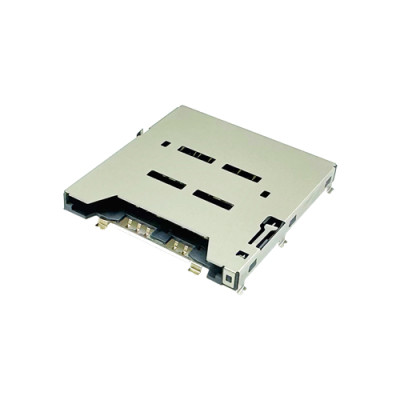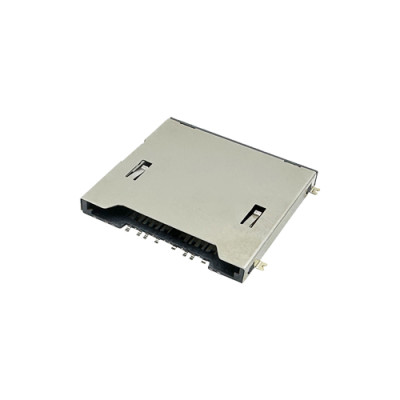
Why Micro SD Card Connectors Become the Weakest Link in Raspberry Pi Systems
Introduction
In the Raspberry Pi ecosystem, discussions about system reliability often focus on processors, power supplies, operating systems, or SD card endurance. However, one critical component is frequently overlooked: the Micro SD card connector itself.
For many Raspberry Pi deployments — especially in industrial IoT, edge AI, robotics, surveillance, and unattended embedded systems — the Micro SD card connector is often the true weakest link in the storage architecture.
Unexpected boot failures, random file corruption, intermittent read/write errors, and unstable system behavior are not always caused by the SD card itself. In many real-world scenarios, the root issue originates from unstable contact interfaces, vibration-induced micro-disconnects, signal degradation, or connector wear.
As Raspberry Pi systems continue expanding into industrial and commercial applications, connector-level reliability is becoming increasingly important. This article explores why Micro SD card connectors become failure points in Raspberry Pi systems, the hidden electrical and mechanical reliability challenges involved, and how Moarconn improves long-term storage reliability with industrial-grade connector solutions.
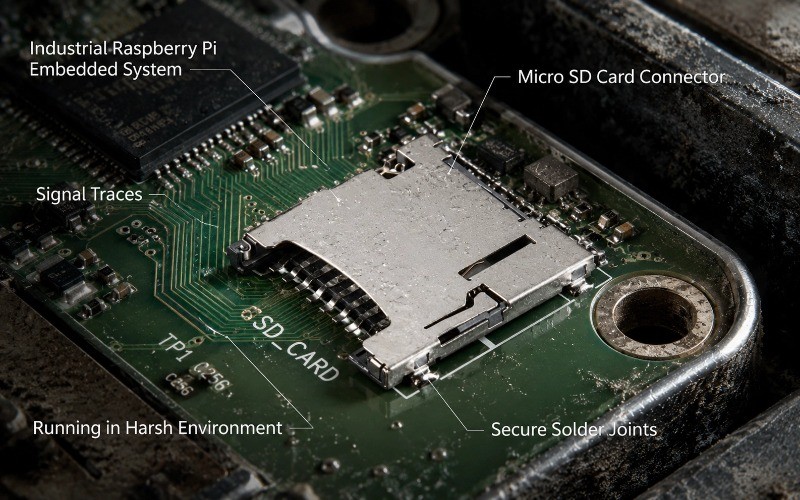
Why Raspberry Pi Systems Depend Heavily on Micro SD Storage
Unlike traditional computers that use SSDs or eMMC storage, most Raspberry Pi boards boot directly from Micro SD cards. The SD card handles operating system storage, bootloader execution, file system operations, log writing, database activity, and application data storage.
This means the Micro SD subsystem is constantly active. Even under light workloads, Linux continuously performs metadata updates, cache flushing, and journaling writes. Over time, this places significant stress on both the SD card and the connector interface.
As a result, even a minor instability at the connector level can eventually lead to system-wide failures.
The Connector Interface Is More Than a Simple Socket
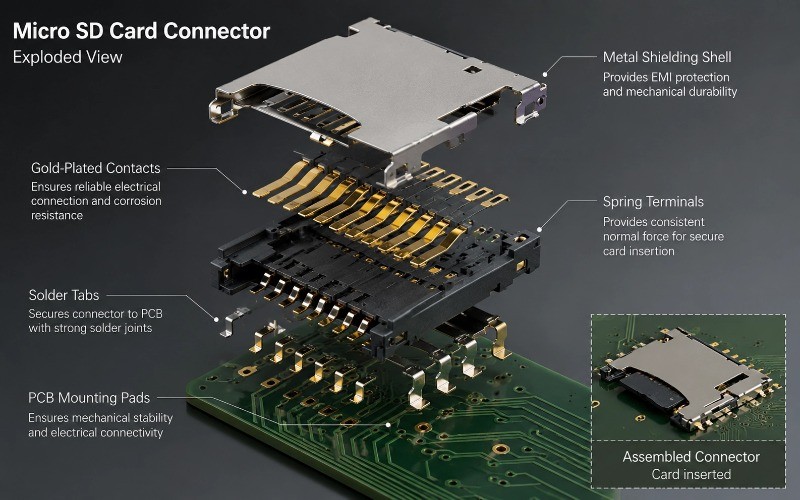
Many engineers mistakenly treat a Micro SD connector as a simple mechanical holder. In reality, it is a highly sensitive electromechanical interface that directly impacts storage reliability.
A reliable Micro SD connector must maintain stable contact resistance, consistent contact force, strong EMI resistance, reliable signal transmission, and long-term insertion durability.
Any instability at the contact interface can directly affect signal integrity and data stability. This becomes especially critical in Raspberry Pi systems because the SDIO interface continuously handles high-frequency communication between the processor and storage device.
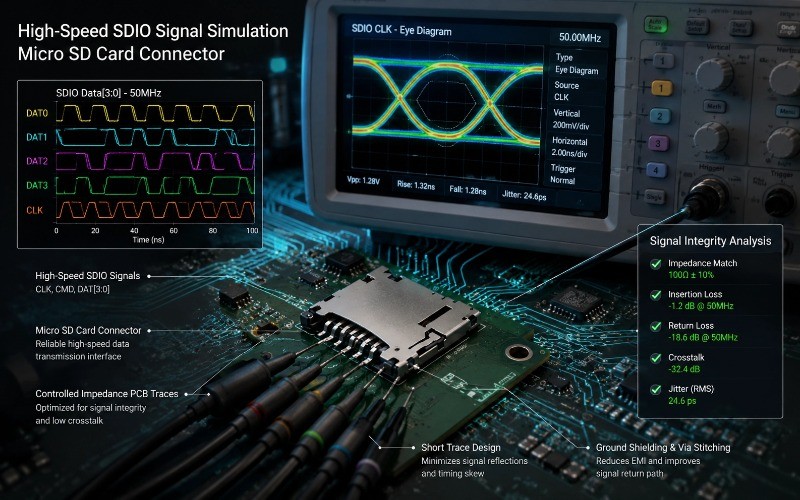
Why Micro SD Connectors Become the Weakest Link
Vibration Creates Micro-Disconnects
In industrial and embedded applications, Raspberry Pi systems are often exposed to vibration, movement, shock, and temperature cycling. Even microscopic movement between connector contacts and SD card pads can create intermittent electrical disconnects.
Although these disconnects may last only milliseconds, that is enough to interrupt write operations and corrupt data. Typical symptoms include random reboot loops, read-only file system errors, disappearing boot partitions, and intermittent card detection failures.
Contact Oxidation Increases Resistance
Humidity and environmental contamination gradually oxidize contact surfaces. As oxidation increases, contact resistance rises and signal quality degrades.
Over time, unstable SDIO communication becomes more likely, especially in systems operating continuously for long periods. Industrial-grade connectors typically reduce this risk through thicker gold plating, stronger wiping action, and improved contact geometry.
Consumer-Grade Connectors Are Not Designed for Industrial Loads
Most low-cost Micro SD connectors are originally designed for smartphones, cameras, and consumer electronics. These products usually operate in stable indoor environments with limited insertion cycles and relatively short product lifetimes.
Raspberry Pi deployments in industrial automation, AI edge computing, and unattended systems create far more demanding reliability requirements.
Signal Integrity Challenges in Raspberry Pi Systems
As SDIO transmission speeds increase, signal integrity becomes increasingly sensitive.
Poor connector geometry can introduce impedance discontinuities that cause signal reflection and timing instability. Insufficient shielding may allow electromagnetic interference to affect SDIO communication, especially in drones, motor control systems, industrial gateways, and robotics applications.
At the same time, connector wear can gradually increase contact resistance, leading to CRC errors, unstable read/write behavior, and silent data corruption.
Why Power Loss Makes Connector Problems Worse
Many Raspberry Pi users blame SD cards after sudden corruption events. However, unstable power conditions often expose existing connector weaknesses rather than create entirely new problems.
When voltage drops during write operations, unstable contact interfaces become more vulnerable. Signal margins collapse, incomplete writes occur, and file system corruption spreads rapidly.
This is why power stability and connector reliability must be considered together in long-term embedded system design.
Why Raspberry Pi Compute Modules Moved Toward eMMC
The Raspberry Pi ecosystem itself already acknowledges the reliability limitations of removable Micro SD storage.
The Compute Module series uses onboard eMMC storage because eMMC generally offers better long-term reliability, reduced connector dependency, improved wear leveling, and stronger resistance to vibration-related instability.
This industry trend highlights an important reality: removable Micro SD systems require stronger connector engineering to achieve industrial-grade reliability.
How Moarconn Improves Micro SD Connector Reliability
At Moarconn, Micro SD card connectors are engineered specifically for industrial and embedded applications that require long-term stability.
Instead of treating connectors as generic commodity parts, Moarconn focuses on signal integrity, vibration resistance, insertion durability, and environmental reliability.
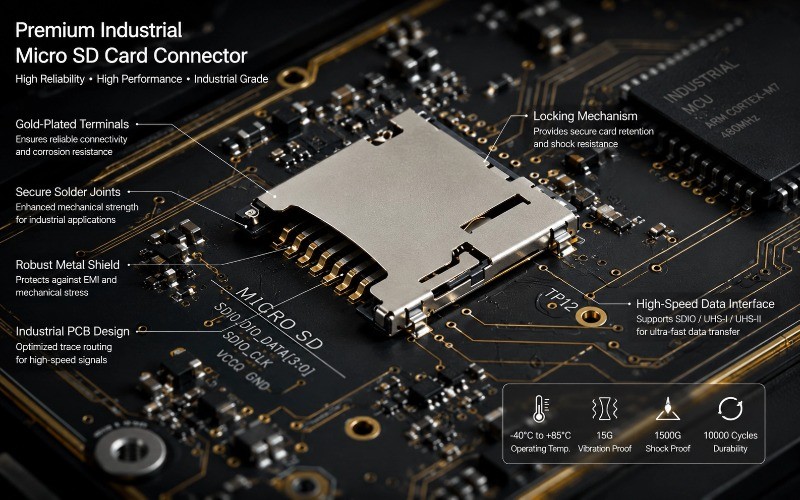
Moarconn connectors use reinforced contact structures to maintain stable contact force under vibration conditions. Enhanced gold plating reduces oxidation and long-term resistance instability. Optimized shielding structures improve EMI resistance and SDIO signal stability, while stronger retention designs minimize card movement during operation.
These engineering improvements help embedded designers reduce long-term storage instability in Raspberry Pi systems.
PCB Design Recommendations for Stable Raspberry Pi SDIO Systems
Even the best connector requires proper PCB integration.
SDIO traces should remain short to reduce signal reflection and propagation delay. Continuous ground planes should be maintained near the connector area to improve return path integrity. Proper shell grounding helps reduce EMI interference, while minimizing via usage reduces impedance discontinuities.
Power stability is equally important. Clean 3.3V rails, low ESR capacitors, and proper decoupling placement can significantly improve long-term storage stability.
Conclusion
Micro SD card connectors are no longer passive components in Raspberry Pi systems. They are critical reliability and signal interfaces.
As Raspberry Pi applications continue expanding into industrial automation, robotics, surveillance, AI edge computing, and embedded control systems, the reliability demands placed on Micro SD connectors continue to increase.
The weakest link is often not the processor, software, or even the SD card itself. It is the connector interface between them.
For engineers building long-term, high-reliability Raspberry Pi systems, choosing an industrial-grade Micro SD connector can significantly reduce signal instability, intermittent disconnects, vibration-related failures, and long-term data corruption risks.
Explore more industrial Micro SD connector solutions at Moarconn.