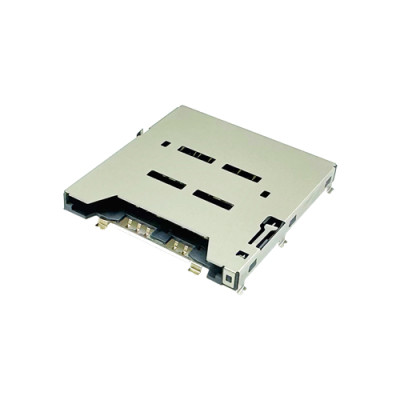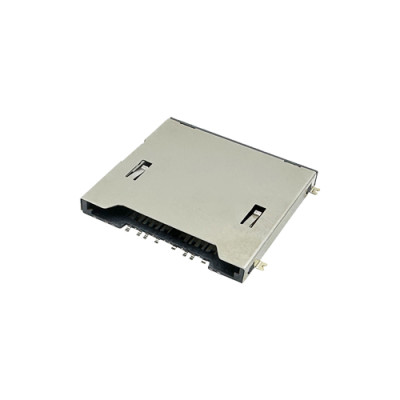
SD Card Connectors Design Evolution: From Simple Socket to High-Speed Interconnect System
1. Introduction: SD Card Connectors Are No Longer Passive Components
SD card connectors were once considered simple mechanical interfaces used only for inserting and removing memory cards.
However, with the introduction of high-speed standards such as UHS and SD Express, SD card connectors have evolved into critical elements of high-speed signal transmission systems.
According to the SD Association, modern SD Express architecture integrates PCIe and NVMe protocols into the SD form factor, significantly increasing bandwidth and system complexity.
Today, SD card connectors must be treated as electrical and mechanical interconnect systems, not passive sockets.
At Moarconn (www.moarconn.com), we design SD card connectors for industrial, automotive, and embedded applications where signal integrity, durability, and mechanical precision are equally critical.
2. SD Card Connector Evolution: Three Major Generations
2.1 First Generation: Basic SD Socket
Low-speed parallel interface
Simple mechanical contact design
Minimal signal integrity requirements
Large physical footprint
At this stage, connectors functioned primarily as mechanical holders.
2.2 Second Generation: UHS High-Speed Era
With UHS-I and UHS-II standards:
Increased data transmission speed
Introduction of serial high-speed signaling
Growing importance of impedance control
Emergence of EMI concerns
The connector began to behave as part of a transmission system.
2.3 Third Generation: SD Express Era
SD Express introduces a major shift:
PCIe differential signaling
NVMe protocol integration
Multi-gigabyte per second bandwidth capability
Backward compatibility with legacy SD interfaces
The SD card connector is now part of a high-speed interconnect architecture similar to SSD systems.
3. Signal Integrity Challenges in Modern SD Card Connectors
Modern SD card connectors must meet strict electrical requirements:
Impedance control (85–100Ω differential)
Crosstalk suppression
Insertion loss minimization
Eye diagram integrity at high speeds
Connector and PCB must be co-designed as a unified system.
4. Miniaturization vs Performance Trade-Off
As devices become smaller, SD card connectors face increasing design constraints:
Mechanical challenges:
Reduced contact pitch
Lower structural tolerance
Higher alignment precision requirements
Electrical challenges:
Increased EMI sensitivity
Reduced isolation distance
Higher crosstalk risk
Miniaturization requires a balance between mechanical strength and electrical performance.
5. High Insertion Life Reliability Engineering
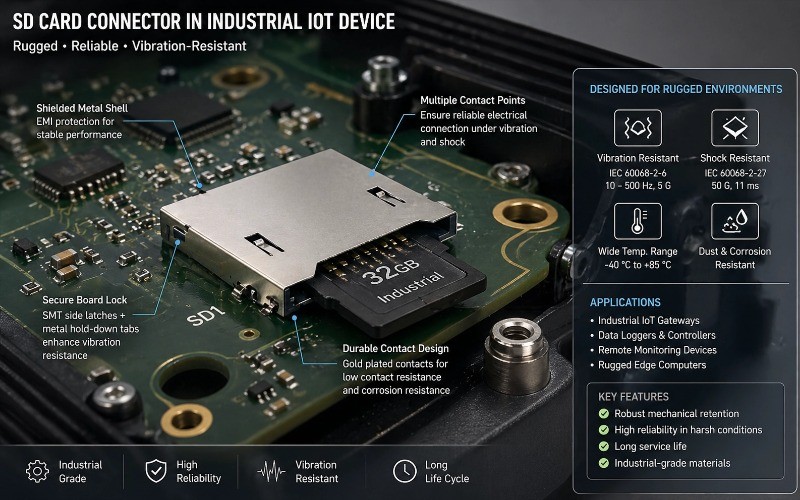
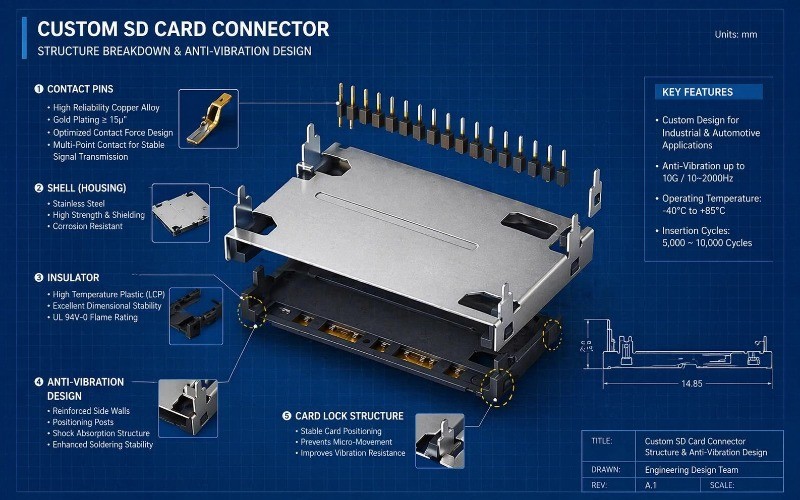
Industrial applications require SD card connectors with long lifecycle performance:
5,000–10,000 insertion cycles
Stable contact resistance over time
Resistance to vibration and humidity
Failure mechanisms include:
Contact wear
Spring fatigue
Oxidation and corrosion
Moarconn focuses on optimized contact geometry and high-reliability plating systems.
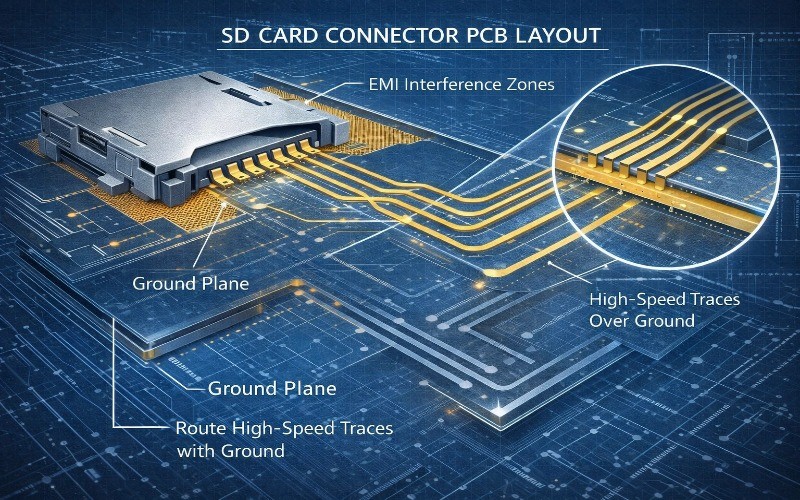
6. PCB Design Guidelines for SD Card Connectors
Key engineering practices include:
Connector placement at PCB edge
Controlled impedance routing
Differential pair length matching
Continuous ground plane design
EMI shielding optimization
Proper PCB design is essential for maintaining signal integrity in SD Express systems.
7. Moarconn Engineering Perspective
At Moarconn, SD card connectors are designed as high-speed electromechanical interconnect systems rather than commodity components.
Our engineering capabilities include:
SD / microSD / SD Express connector systems
Industrial-grade reliability design
Automotive and IoT applications
OEM / ODM customization services
Learn more: https://www.moarconn.com
8. Application Scenarios
SD card connectors are widely used in:
Industrial automation systems
Automotive electronics
UAV and drone imaging systems
Edge AI computing devices
Embedded storage modules
9. Future Outlook
With the rise of SD Express and PCIe-based architecture:
SD connectors will continue evolving toward high-speed interconnect systems
Mechanical and electrical co-design will become mandatory
System-level signal integrity will define product performance