
6-Pin vs 8-Pin SIM Card Connector: When Do You Need the Detect Pin?
The core difference is simple: a 6-pin SIM card connector carries the five essential ISO 7816 contacts (VCC, RST, CLK, GND, I/O) plus one auxiliary pin, while an 8-pin SIM card connector exposes the full C1-C8 contact set and typically adds a card-detection switch that tells the host the SIM is seated and locked. Choose 6-pin for standard mobile communication, choose 8-pin when your device must detect insertion, support hot-swap logic, or meet industrial fault-reporting requirements.
6-Pin vs 8-Pin SIM Card Connector: Side-by-Side Comparison
| Feature | 6-Pin SIM Connector | 8-Pin SIM Connector |
|---|---|---|
| ISO 7816 contacts | C1, C2, C3, C5, C7 + 1 auxiliary | Full C1-C8 set |
| Card-detection switch | Usually not available (some models add 2 switch pins) | Commonly integrated detect pin |
| Typical height | 1.45 - 2.00 mm | 0.45 - 1.60 mm ultra-low profile |
| Insertion detection | No | Yes - host knows if the SIM is inserted |
| Hot-swap support | Limited | Better - power sequencing with detect signal |
| Typical applications | Feature phones, IoT modules, POS terminals | Industrial gateways, automotive T-Box, security & monitoring devices |
| Cost | Lower | Slightly higher (switch mechanism) |
What the Detect (Card-Detection) Pin Actually Does
The detection switch is a tiny mechanical contact inside the socket. When the SIM card is fully inserted and latched, the switch closes and reports a logic signal to the host. Engineers use it for three jobs:
- Insertion check: the system knows whether a SIM is present before powering the interface, avoiding pointless polling.
- Fault reporting: industrial and security equipment can log "SIM removed" events for remote diagnostics.
- Power sequencing: VCC is applied only after the card is seated, protecting both the SIM and the host controller during hot-swapping.
How to Choose: 3 Practical Rules
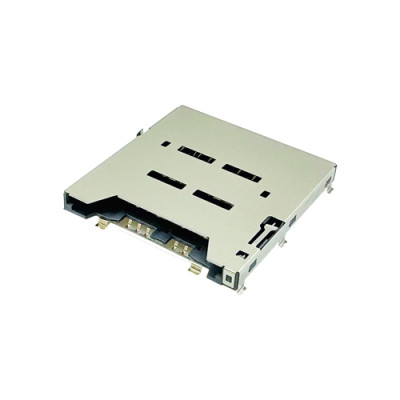
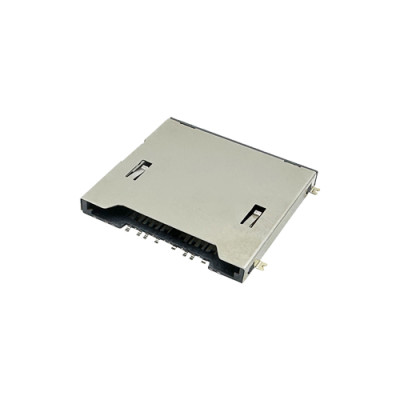
- Rule 1 - Match the host protocol, not just the pin count. If your baseband expects a presence signal, a 6-pin socket will fail silently in the field. Check the reference design first. For a compact option see our 8-pin SIM card connector with 2 switch pins (H 0.45mm).
- Rule 2 - 6-pin wins on cost and simplicity. For phones, IoT dataloggers and POS terminals that never hot-swap, a standard 6-pin connector with 2 switch pins (H 1.45mm) keeps BOM cost down.
- Rule 3 - Industrial = detect pin + gold plating. For automotive, security and always-on gateways, pair the 8-pin socket with 0.3µm+ gold-plated contacts. Browse all options in our SIM card connector catalog, and read the C1-C8 pin function guide for the electrical definition behind each contact.
Need a datasheet or a free sample to verify the fit? Get samples from MoarConn - quotation within 48 hours, first sample in 20 days.
Are you looking for a reliable manufacturer of card connector products?
We can quickly provide customers with market analysis, technical support and customized services.- Phone
- *Title
- *Content